



































































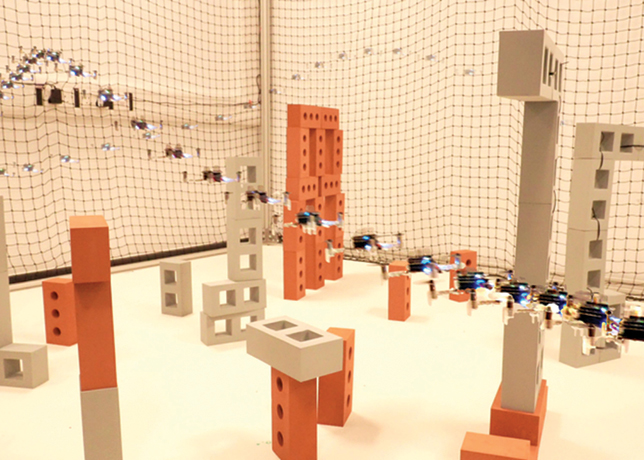
Researchers at Durham University have developed CORTO-Planner, a new autonomous drone navigation system designed to enable faster, smoother and safer flight through crowded environments.
Published in IEEE Robotics and Automation Letters, the system uses a flexible “piecewise parametric safe corridor” to give drones greater freedom to manoeuvre while avoiding obstacles.
Tests showed the approach can provide up to six times more usable flight space and 59 per cent wider obstacle clearances than previous methods.
The system’s efficient computing enables real-time responses to changing surroundings without sacrificing safety or speed.
Trials on real drones and in simulations involving narrow gaps, sharp turns and maze-like courses showed CORTO-Planner achieved faster flight times and higher average speeds than several existing navigation systems.
Researchers said smoother flight could also improve battery efficiency and reduce component wear.
The technology could support applications including search and rescue, infrastructure inspection, forest exploration, warehouse automation and environmental monitoring.
The team has made the software openly available and said the underlying technology could also be adapted for other autonomous systems, including self-driving vehicles, robotic arms and underwater robots.