












European electrolyser manufacturers currently have enough capacity to meet near-term hydrogen orders, but a shortage of investable projects is leaving factories underused and putting the region’s 2030 hydrogen ambitions at risk, according to a report by the Energy Industries Council (EIC).
The EIC estimates Europe’s current maximum electrolyser
manufacturing capacity at 8.49 GW annually, although the figure includes
Topsoe’s 500 MW-per-year plant in Denmark, which is currently inactive, and
excludes smaller manufacturers with undisclosed capacity.
The bigger challenge is project development.
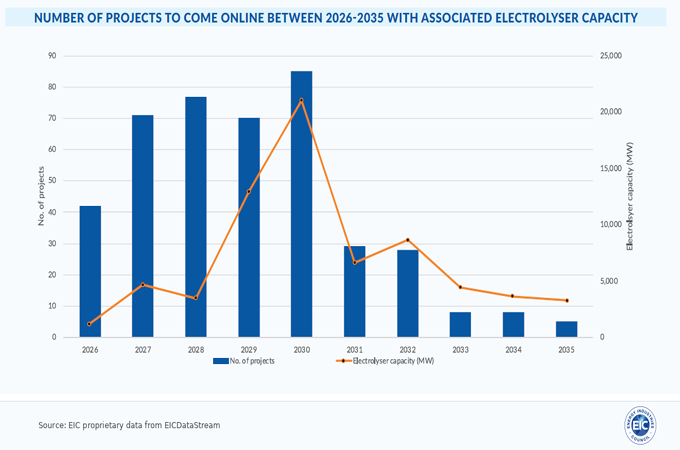
Of the 31 GW of green hydrogen capacity planned for 2030,
only around 3 GW has reached a final investment decision (FID).
High production costs, uncertain demand, changing
regulations and a lack of long-term offtake agreements are preventing many
projects from securing financing.
The EIC expects manufacturers to meet anticipated orders in
2027 and 2028, when the market is likely to remain oversupplied.
However, equipment
shortages could emerge from 2029 if more projects secure investment approval.
Europe has recorded 624 hydrogen projects since 2020,
covering production, pipelines, storage and related infrastructure.
Only 59 are operational, while 74 have been cancelled.
Of the remaining projects, nearly half are still at the
feasibility stage and around 15 per cent are on hold.
Green hydrogen accounts for 395 proposed developments, while
pipelines represent 57.
The EIC warned that production and transport infrastructure
could struggle to develop in parallel, particularly as many infrastructure
projects remain at early stages.
Rebecca Groundwater, EIC Global Head of External Affairs,
said policy should focus on converting project pipelines into firm demand
through faster support decisions, clearer long-term offtake rules and
coordinated investment in transport and storage.
The UK has Europe’s largest national hydrogen pipeline, with
130 proposed projects, but only 8 per cent are under or awaiting construction.
The EIC forecasts 3.66 GW of electrolytic capacity by 2030,
more than 1 GW below the government’s 5 GW target.
Germany is further advanced, with 87 proposed projects and
23 per cent under or awaiting construction. Its planned 9,000 km Hydrogen Core
Network and import connections could position it as a major European demand
hub.
Spain has 54 proposed projects, although 60 per cent remain
at feasibility stage, while Scandinavia has 76 projects, with 18 per cent under
or awaiting construction.
Across Europe, the EIC estimates that proposed projects
represent around 72 GW of electrolyser capacity and $269 billion in potential
capital expenditure.
However, without a sharp increase in FIDs, manufacturers could face weak order books in the near term, while accelerated investment could create equipment supply constraints from 2029. -OGN/TradeArabia News Service