





















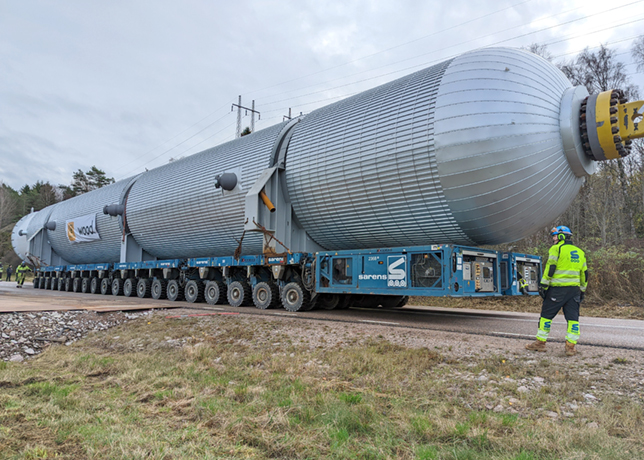





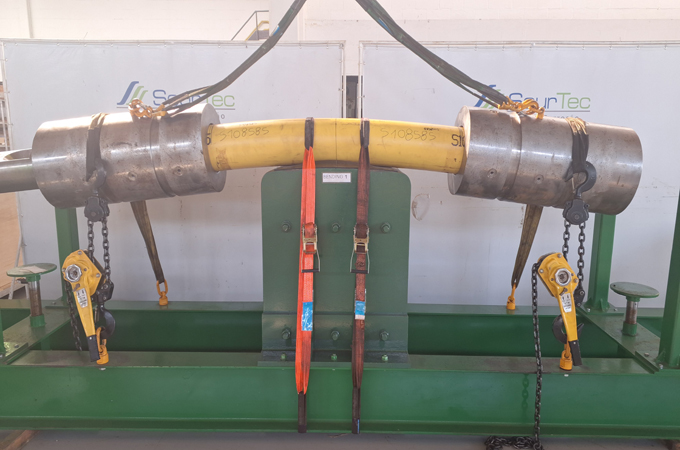
Strohm has completed a joint industry programme (JIP) with Petrobras and Shell to qualify its Thermoplastic Composite Pipe (TCP) flowline technology for demanding Brazilian pre-salt conditions, marking a major step towards offshore deployment of corrosion-free flowlines.
The programme combined full-scale qualification with an
extensive offshore field trial, creating what Strohm describes as the world’s
most advanced initiative to bring TCP flowlines into actual offshore field
conditions.
The technology is
designed to provide a 30-year service life and could support wider adoption of
non-metallic flowlines in Brazil’s deepwater market.
Brazil’s pre-salt fields contain some of the world’s most
productive wells but also present significant pipeline integrity challenges
because of high CO₂ concentrations.
Conventional flexible pipes can be vulnerable to stress
corrosion cracking, potentially causing premature failures and requiring
replacement of flowlines, which can contribute to deferred production.
The JIP delivered a fully qualified flowline designed for
the most demanding Brazilian pre-salt environments, including high-CO₂
conditions.
Strohm said its qualification methodology included
system-representative testing of the pipe, end-fitting and sealing interfaces
under realistic operating conditions.
Martin van Onna, Strohm’s CEO commented: “The project has
great strategic relevance for the subsea sector in Brazil and beyond, as it
decisively solves one of the major pipeline integrity challenges identified in
recent years: the risk of stress corrosion cracking in environments with a high
CO₂ concentration. By using non-metallic TCP, corrosion is simply eliminated,
strengthening system integrity and operational reliability in challenging
subsea environments.”
He added: “Strohm’s TCP flowline is designed to be installed
by today’s installation vessels without the need to change anything. The
installation procedures do not require material changes and the pipeline’s
behaviour both on the vessel and subsea during installation is fully
predictable and in line with industry practice. Strohm’s TCP can be considered
as a suitable replacement for flexible lines currently vulnerable to corrosion
and we are ramping up production capacity to meet the expected demand.”
Under the programme, DNV qualified a 6-inch carbon
fibre-PA12 TCP for alternating water and gas injection (WAG) service used in
enhanced oil recovery, in accordance with DNV-ST-F119. The qualification
involved more than 50,000 testing hours, equivalent to six calendar years,
covering materials, sealing and full-scale testing.
More than 40 individual full-scale tests were conducted
across seven laboratories and certified testing houses in Europe and Brazil.
The programme also built on earlier material testing
conducted by supplier Evonik.
Ramón Rojas, JIP programme manager at Strohm said: “The
development is based on a fully integrated methodology that combines
engineering design, material selection, structural analysis and full scale
validation. This approach ensures that predicted and actual performance are
aligned, providing a high level of confidence in the system’s behaviour under
demanding operational conditions and guaranteeing reliability throughout its 30
year service life.”
Philippe Noury, technical lead for the DNV verification,
added: “This qualification provides the independent technical basis for moving
into the planned pilot. It also gives the industry a practical example of how
non-metallic flowlines can be assessed under DNV-ST-F119 for demanding,
high-CO₂ deepwater service.”
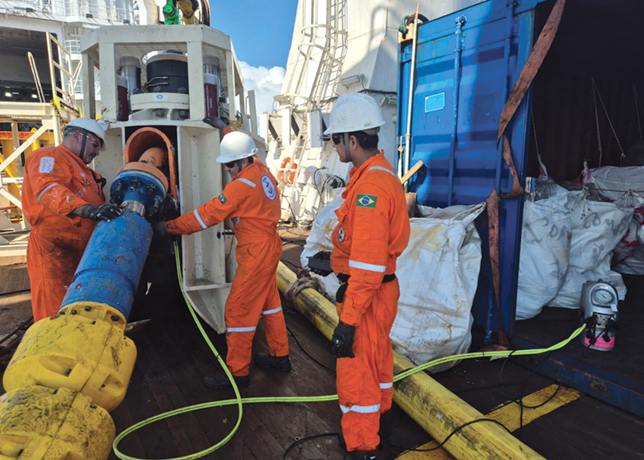
Offshore field trials were completed in July 2026, including
deep immersion performance tests and subsea vertical connection tests.
The trials assessed the pipe’s robustness during handling,
installation and subsea connection.
The qualification and field trial clear the way for
Petrobras to install and operate a TCP pilot flowline in a Brazilian pre-salt
field, planned for early 2027.
Strohm said the
technology also offers high fatigue performance and lower weight than steel,
enabling installation using vessels of convenience. -OGN/TradeArabia News Service