




























































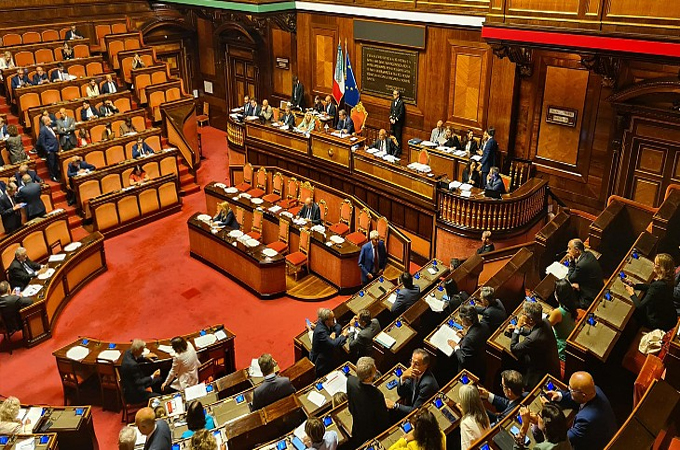
Italy’s Senate has approved legislation paving the way for the country to return to nuclear power after more than four decades, passing the government-backed bill by 81 votes to 51, with seven abstentions, reported World Nuclear News.
The legislation, promoted by Prime Minister Giorgia Meloni’s
government, gives the executive authority to establish a regulatory framework
for the introduction of what it calls “sustainable” nuclear energy.
The measure is linked to Italy’s goals of strengthening
energy security, reducing fossil-fuel dependence and achieving climate
neutrality by 2050.
Environment and Energy Security Minister Gilberto Pichetto
Fratin said the vote marked a step towards Italy’s energy future.
He argued that nuclear power, combined with renewable
energy, could contribute to energy security and decarbonisation while
supporting economic and industrial development.
The government’s mandate includes creating a National
Programme for Sustainable Nuclear Power, establishing an independent Nuclear
Safety Authority, expanding scientific and industrial research, developing
specialist skills and launching public information initiatives.
Officials have stressed that decisions should be based on
scientific evidence and technical assessments, with local communities involved
in the process.
The bill had already passed Italy’s lower house, the Chamber
of Deputies, in June, with 155 votes in favour, 86 against and eight
abstentions.
Italy is also exploring small modular reactors (SMRs) and
advanced nuclear technologies.
French nuclear developer Nuward, its parent company EDF,
Edison and Italian industrial groups Ansaldo and Maire have expressed a shared
ambition to deploy a first SMR in Italy by 2035.
Nuward has said it aims to develop a fleet of 10 SMRs across
five EU countries, with initial construction planned from 2030.
Advanced reactor developer Newcleo, which has significant
operations in Italy, is also developing lead-cooled fast-reactor technology and
has been assessing potential applications with the country’s cement industry.
Italy previously operated four nuclear power plants from the
1960s but abandoned nuclear power following a referendum held after the 1986
Chernobyl disaster.
Its final two operating reactors, at Caorso and Trino
Vercellese, closed in 1990.
A proposed nuclear revival was again halted after the
Fukushima Daiichi accident in 2011.
In a referendum that year, 94 per cent of participating
voters rejected plans to build new reactors.
Public and political attitudes have since shifted.
A 2021 poll found that about one-third of Italians supported reconsidering nuclear power, while Parliament in 2023 urged the government to examine its potential role in the national energy mix.