





























































Stopping new plastic from entering the oceans is essential but will not be enough to prevent the continued accumulation of microplastics, according to a new study by researchers from Ritsumeikan University and international partners.
The research shows that reducing plastic at its source must
be combined with timely cleanup of existing marine debris, particularly larger
plastic waste that can gradually fragment into smaller particles.
The study, published in Communications Earth &
Environment on September 12, 2026, used a system dynamics model to assess how
different combinations of plastic source reduction and cleanup strategies could
affect marine plastic pollution through 2050.
Researchers examined the transport, degradation and removal
of initially buoyant macroplastics across shorelines, coastal waters and
offshore areas, as well as their eventual breakdown into microplastics.
The research team included Professor Takuro Uehara of
Ritsumeikan University, Dr. Mateo Cordier of Université de
Versailles-Saint-Quentin-en-Yvelines—Université Paris-Saclay in France, and
Laurent Lebreton of The Ocean Cleanup in the Netherlands.
“The framework is designed to look at marine plastic
pollution as a dynamic problem rather than a one-time cleanup challenge.” Says
Prof. Uehara. “By linking plastic inputs, the movement and breakdown of debris,
cleanup timing and location, and the associated costs, it allows to explore
which combinations of prevention and cleanup could be both environmentally
effective and economically realistic. This provides a basis for more informed
decisions about where and when cleanup efforts should be prioritized.”
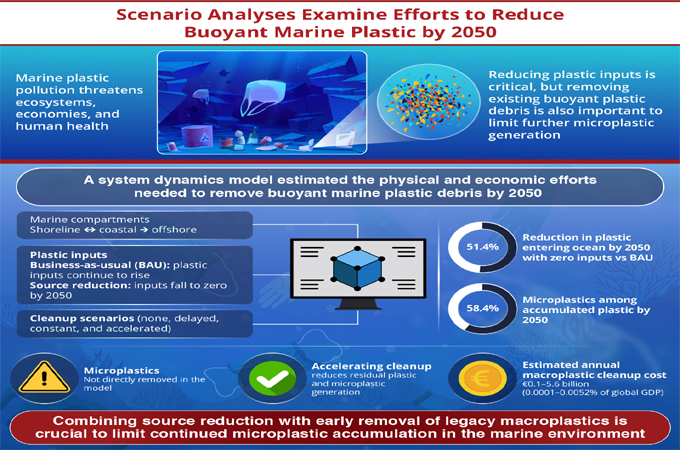
The researchers tested seven scenarios combining different
levels of plastic source reduction with varying cleanup strategies.
In scenarios targeting the elimination of new marine plastic
inputs, pollution entering the ocean was progressively reduced from 2026 until
reaching zero by 2050.
The researchers then compared delayed, constant and
accelerated cleanup strategies to determine how timing and intensity would
affect the amount of plastic remaining in the ocean.
The modelling found that halting plastic inputs by 2050
could reduce the cumulative amount of plastic entering the ocean between 1950
and 2050 by 51.4% compared with a business-as-usual scenario.
However, source reduction alone would not eliminate the
existing stock of marine plastic.
Without cleanup, microplastics were projected to account for
58.4% of accumulated marine plastic by 2050.
The study also found that cleanup without reducing new
plastic inputs would be insufficient to address the scale of the problem.
For example, delayed cleanup under the business-as-usual
scenario was projected to leave approximately 10,319 kilotonnes (kt) of
microplastics in the ocean by 2050, compared with about 10,146 kt when source
reduction was combined with delayed cleanup.
The researchers found that the timing of cleanup was
critical.
All of the cleanup strategies examined focused on removing
macroplastics rather than microplastics, which remain difficult and costly to
recover at2050.
Under a source-reduction scenario with delayed cleanup,
approximately 10,168 kt of plastic remained in the ocean.
That figure fell to 8,824 kt with constant cleanup and to
7,312 kt when large scale.
Among scenarios combining source reduction with
comprehensive cleanup, accelerated action produced the lowest amount of
remaining plastic by 2050.
Under a source-reduction scenario with delayed cleanup,
approximately 10,168 kt of plastic remained in the ocean.
That figure fell to 8,824 kt with constant cleanup and to
7,312 kt when cleanup was accelerated.
The findings suggest that removing larger plastic debris
before it breaks down into microplastics can significantly reduce future
accumulation. Early intervention is particularly important because existing
large-scale technologies are not effective at recovering microplastics once
they are widely dispersed.
However, the researchers also highlighted the substantial
financial costs associated with faster cleanup.
Delayed full cleanup was estimated to cost an average of €1
billion annually, while accelerating cleanup between 2026 and 2050 could raise
annual costs to around €3.4 billion.
Offshore cleanup operations are more expensive than efforts
carried out closer to shore. Costs can also rise over time as cleanup
operations remove the most accessible concentrations of plastic, leaving
smaller and more dispersed quantities that are increasingly expensive to
recover.
The study’s findings have implications for international
efforts such as the Osaka Blue Ocean Vision, which seeks to halt additional
marine plastic pollution by 2050 and was endorsed alongside the G20
Implementation Framework for Actions on Marine Plastic Litter.
The researchers stressed that preventing plastic from
entering the environment remains the most important long-term measure.
Upstream action could include reducing plastic production
and consumption, improving waste collection and strengthening recycling
infrastructure.
Industries also have a role to play by reconsidering
production practices and identifying more sustainable levels of plastic
manufacturing.
The study suggests that relying primarily on large-scale
cleanup operations would place significant financial and technological burdens
on governments and other organisations.
Prof. Uehara said, "The scale of marine pollution
demands more than just better cleanup strategies. Relying on massive recovery
efforts to balance out unchecked plastic waste is a structurally unsustainable
solution."
Overall, the research concludes that source reduction and
cleanup should be pursued together rather than treated as alternatives.
Eliminating new plastic inputs by 2050 could substantially
reduce future pollution, but existing marine debris will continue to fragment
unless it is removed.
Accelerating targeted cleanup while macroplastics remain
recoverable can therefore limit the formation of additional microplastics,
although significant accumulation is expected to remain.
The study highlights the need for policymakers to balance environmental effectiveness, cleanup timing and financial costs while prioritising measures that prevent plastic waste from reaching marine environments in the first place. -TradeArabia News Service