
























































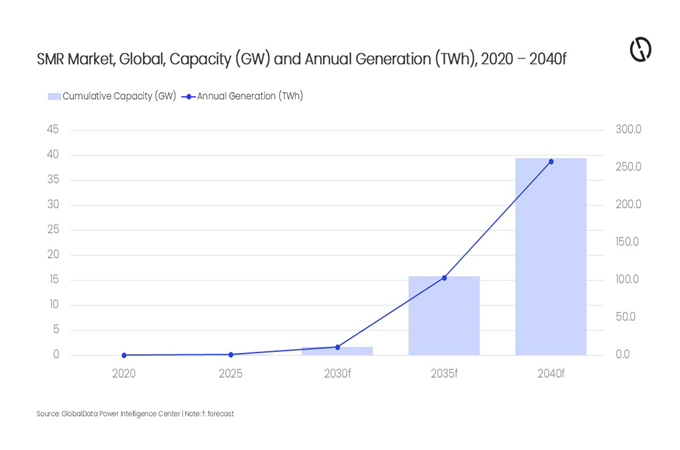
Small modular reactors (SMRs) are emerging as a key technology in the global shift to low-carbon, secure and flexible energy systems, with capacity forecast to rise roughly sixfold between 2025 and 2030, according to GlobalData.
In its report SMR Power Market, Update 2026 – Market
Size, Segmentation, Major Trends, and Key Country Analysis to 2035,
GlobalData says deployment strategies vary by region.
China is advancing multiple designs including light-water
SMRs, high-temperature gas reactors and molten-salt prototypes, while South
Korea is focusing on integral pressurised water reactors and
desalination-capable systems.
However, the sector remains largely early-stage, with more
than 90 per cent of proposed capacity still in announcement or permitting
phases.
The report warns that commercial success will depend on
whether early projects can demonstrate cost control, regulatory approval and
reliable delivery timelines.
Early deployment leaders include Russia and China, which
already have SMR projects under construction or demonstration, supported by
established nuclear supply chains and state backing.
The US has a growing pipeline supported by federal funding
and regulatory reforms, but continues to face first-of-a-kind project risks.
Other markets, including the UK, Canada and several Central
and Eastern European countries, are accelerating planning but remain
constrained by costs and licensing timelines.
A major driver of demand is rising electricity consumption
from data centres, with technology companies increasingly exploring SMR
partnerships to secure stable, low-carbon power for AI and digital
infrastructure.
Despite strong momentum, challenges remain around
regulation, supply chains and public acceptance.
Analysts say
resolving these issues will be critical if SMRs are to move from demonstration
projects to a meaningful role in global electricity systems by the mid-2030s.
Attaurrahman Saibasan, Power
Analyst at GlobalData, comments: “SMR capacity is projected to increase by over
a hundredfold by 2040 relative to 2025. The substantial growth forecast is
being driven by surging demand for zero-carbon firm power, industrial cleantech
uses, and greater emphasis by policymakers on energy security.”
Saibasan adds: “Governments worldwide are implementing
supportive policies, including financial incentives, streamlined licensing
processes, and public-private partnerships, to accelerate SMR deployment. These
measures are crucial to overcome the initial financial and regulatory hurdles
associated with FOAK projects.”
Saibasan concludes: “Securing financing for FOAK SMRs requires risk sharing through public investment, guarantees, contracts for difference (CfD), regulated asset base models, or capacity payments. Investors need predictable revenue streams and clarity on regulatory and licensing commitments. Offtake agreements, utility partnerships, and industrial anchor customers can enhance bankability. Governments must consider enabling financial instruments to de-risk early projects, protect against cost overruns, and support supply chain scale-up. Early successes or failures will have outsized effects on the broader investment environment.” -OGN/TradeArabia News Service