
















































The global oil and gas fabrication sector is under acute pressure to deliver ever larger, more complex topsides structures with compressed schedules, tighter safety margins and quantifiable cost efficiencies.
In such a context, fabrication yards are increasingly integrating heavy lifting considerations earlier in project planning to harmonise construction phases and minimise the interface risks between fabrication, load-out and transportation.
In a project, Mammoet, a heavy-lifting specialist, outlined how its early involvement in the fabrication and load-out operations for the Scarborough Project’s floating production unit (FPU) at a Chinese yard delivered measurable advantages in time, safety and sequencing of work.
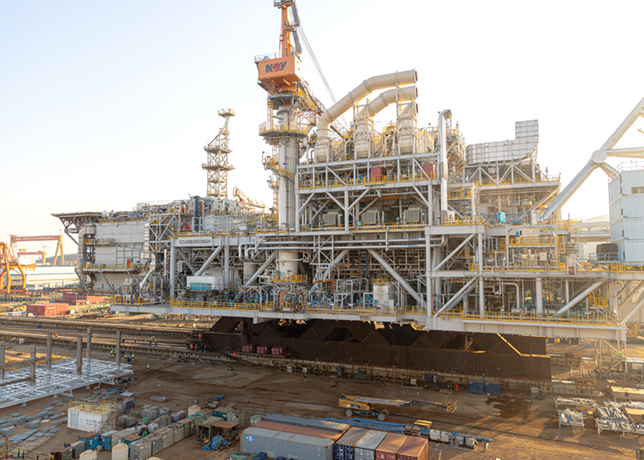
At Qingdao McDermott Wuchuan’s fabrication facility in China, Mammoet was contracted to undertake the weighing, jacking and load-out of the 33,000-tonne FPU topsides for Woodside Energy’s Scarborough Project.
The FPU comprised two principal elements: The deck support frame (DSF) and the topsides module itself, which would ultimately be seated onto the DSF.
Mammoet’s engagement on this workstream dated back eight years, when it was invited by the topsides design team to participate in early discussions on optimal build methodologies.
Those consultations informed an approach that combined an integrated weighing and jacking solution with the fabrication of a bespoke starter beam, intended to deliver tangible time and cost benefits across multiple project stages.
According to the report, Mammoet’s engineers proposed a strategy that eliminated discrete weighing operations by integrating measurement capability with the jacking system.
This dual-function approach was anchored in the deployment of the company’s Mega Jack system, a high-capacity jacking arrangement that enables lifting of some of the heaviest industrial loads from close to ground level, thus reducing working at height for personnel and equipment.
For Scarborough, the project marked the first operational use of the new Mega Jack 10000 system, which permits a lower starting height than previous configurations for similarly heavy loads.
The mobilisation involved configuring multiple jacking bases in a modular assembly that distributed load across the system.
Four Mega Jack towers were arranged beneath the principal load points of the topsides, and 80 load cells with up to 750-tonne measurement capacity each were integrated into the system to facilitate simultaneous lifting and weighing of the module.
This configuration avoided the traditional alternative of separate load cells and hydraulic cylinders positioned at disparate locations under the structure.
As Richard Verhoeff, Sales Director at Mammoet, explained that performing both weighing and jacking with the same system enhanced efficiency across project phases by streamlining these critical operations.
The integrated design also incorporated a bespoke load-spreading beam, engineered by Mammoet and fabricated into the underside of the topsides.
This beam supported the structure during construction and contributed to the jacking operation by enabling the topsides to stand on four primary contact points once the final weight had been verified.
Subsequent to this verification, the topsides were elevated to a height of 16 m via the four towers, creating the clearance necessary to position and connect the DSF beneath the module.
Once engaged, the towers were gradually lowered until the total weight transferred fully onto the DSF.
Following the transfer of load, the topsides were pulled onto the installation barge in incremental 500-mmm steps, utilising eight SJ850 strand jacks and a skidway.
Throughout this process, Mammoet also supported the barge ballasting operation to ensure that the vessel remained level as the significant topsides mass shifted from the bow towards the mid-section.
The integrated system thereby facilitated a controlled and sequenced load-out, combining precision weighing, safe jacking and measured movement onto transport infrastructure.
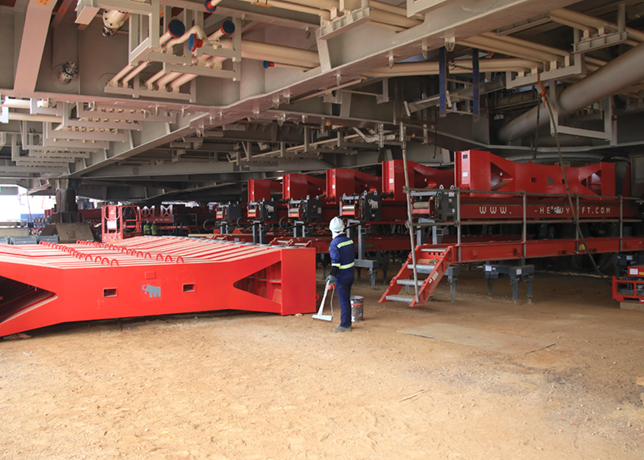
Engineers inspect hydraulic skidding system positioned beneath large offshore module
DRIVERS BEHIND THE ENGINEERING CHOICE
The primary drivers articulated in the source document for this integrated approach were the reduction of working at height, minimisation of mobilisation requirements and optimisation of construction sequencing.
Deploying the Mega Jack 10000 system obviated the need for additional lifting equipment to be brought on site, with attendant savings in both cost and set-up time.
Lowering the surface area of contact points also reduced the requirement for ground reinforcement, a factor of particular relevance in heavy fabrication yards where subsurface conditions can constrain equipment placement.
Crucially, the integrated load-spreading beam eliminated the need for supplemental beams that would otherwise have been necessary, had standard jacking towers been used for equivalent load distribution.
Fabricating the topsides at a lower height, closer to ground level, improved the safety profile of operations by reducing fall distances and lessening the reliance on elevated access equipment.
The absence of extensive additional support steel also contributed to overall efficiencies, both in terms of material handling and in the sequencing of work.
The report highlighted that alternative fabrication schemes, such as constructing the topsides atop its support frame, would have delayed the commencement of topsides work until the support frame was available and could have necessitated elevated fabrication at 16 m above ground.
According to Verhoeff, this would have incurred higher costs due to the need for greater structural support around the build area and more substantial cranes to lift components to the elevated platform.
The alternative methodology would also have extended daily access times for operators transitioning between ground level and elevated work sites.
Further, building the topsides directly on its sea foundation was described as having significant negative impacts on project sequencing, adding extra height and preventing concurrent progression of foundational work and topsides fabrication.
By contrast, the integrated approach allowed parallel execution of discrete project segments, thereby compressing overall schedules without compromising safety or constructability.
Integrating these decisions in the early planning phase, as occurred eight years before load-out, enabled concurrent work streams to be executed at lower elevations and with synchronised interfacing between fabrication and heavy-lift operations.
IMPLICATIONS FOR FUTURE FABRICATION OPERATIONS
The detailed account of the Scarborough topsides operation underscores the implications of early heavy-lift integration on project delivery outcomes in the offshore fabrication sector.
By combining weighing and jacking functionalities, deploying modular high-capacity systems and fabricating custom load-spreading solutions, the project reduced dependency on traditional high-level construction techniques and extensive supplemental equipment.
The approach highlighted the potential for rethinking sequencing and equipment utilisation in large structural builds, particularly where safety and time savings can be quantified through engineering design choices.
Moreover, the integrated system’s capacity to lower work to near–ground level illustrates a shift in how fabrication yards might organise large-scale module construction to mitigate risk and enhance throughput.
Such strategies, as articulated in the source report, have direct implications for yards and operators seeking to align heavy-lift planning with construction methodologies to foster time-efficient and safer fabrication environments.
By documenting the specific technical choices, configuration details and operational drivers used on this project, the report provides data points and engineering rationale that could inform subsequent applications of similar integrated heavy-lifting systems in comparable industrial settings.