





































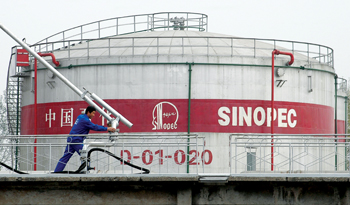
 Sinopec ... undeterred by oil price fall
China’s Sinopec Corp said it was committed to shale gas spending for 2015 despite a sinking global oil market to which domestic gas prices are linked.
Falling oil prices will have no major impact on the company’s plans for natural gas development, Jiao Fangzheng, senior vice president of Sinopec, told a news conference.
Still, Jiao said it was unclear if the central government would continue a subsidy of 0.40 yuan per cubic metre for shale gas production beyond 2015, a key to sustaining early development of the costly unconventional resource.
The country’s second-largest state energy firm has taken the lead in developing China’s potentially huge shale gas resources, having discovered the first large deposits at Fuling in the southwest. Sinopec has said the Fuling field, which has so far produced 1.1 billion cubic metres (bcm) of gas, is on track to reach a capacity of 5 bcm by 2015 and 10 bcm in 2017.
Fuling gas currently sells at 2.48 yuan (40 cents) per cubic metre, which along with the additional subsidy gives Sinopec an internal rate of return of 11 to 13 per cent, a second company official said.
Industry analysts believe global oil prices, which have lost nearly half their value since June, will eventually hit spending on expensive shale gas development, although state giants like Sinopec also take into account government priorities.
“If oil prices remain at $60 for the next few years, then achieving 10 bcm will be a challenge,” said Gordon Kwan, head of Asia energy research at Nomura.
But if oil prices rebound to $80 and higher from 2016, then Sinopec’s shale gas target could be achievable, as the government is expected to hand out more subsidies, Kwan said.
The company forecast an average price of 4,320 yuan ($694) per tonne for crude oil in 2014, Jiao said, but prices have fallen below 3,000 yuan ($482) in December, hitting revenue badly.