





















































 Somya Kapoor
Agentic AI technology achieves up to 40 per cent error reduction whilst freeing quarter of top talent for strategic work, Somya Kapoor tells OGN
IFS Loops is transforming industrial enterprise operations through its deployment of AI-powered digital workers, delivering measurable improvements across procurement, inventory management, and field service operations.
In an exclusive interview with OGN energy magazine, Somya Kapoor, the company’s CEO, claims that its agentic AI technology can free 20-30 per cent of employee capacity whilst reducing errors by up to 40 per cent across multi-system workflows.
The digital workers integrate seamlessly with over 65 enterprise systems to automate previously manual processes.
Built on a modular architecture designed for enterprise scale, IFS Loops leverages decades of industry-specific expertise embedded in IFS’s ERP systems.
The platform enables industrial enterprises to address workforce gaps and manage increasing data complexity whilst redirecting top talent towards strategic initiatives that drive long-term growth.
IFA acquired TheLoops in June 2025, and reintroduced it as IFS Loops.
Below are excerpts from the interview:
How does IFS Loops quantify the 20-30 per cent resource loss caused by manual processes, and what evidence supports this claim?
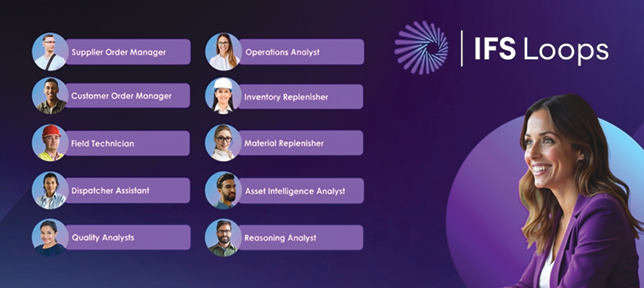 |
IFS Loops’ digital workers keep processes running smoothly 24/7 |
IFS Loops gathers a variety of metrics and statistics including task duration, workflow complexity, staffing requirements, associated overhead and more that forms a baseline.
With each digital worker deployment, we track against this baseline on a month-over-month basis and are able to see savings across time, costs, and efficiency within 30-60 days.
With each deployment, the numbers hold steady: Enterprises consistently see 20-30 per cent of employee capacity freed up to focus on higher-value work.
What specific technologies enable digital workers to achieve faster supplier order confirmations?
The 25-35 per cent improvement in supplier order confirmations comes from a combination of key elements:
• Our domain-specific AI models that understand procurement workflows
• Our proprietary knowledge graph that contextualises data to seed these domain specific LLMs
• Our robust connectors from IFS’s ERP to Microsoft Outlook, Microsoft Teams and other supplier systems
• The agentic capabilities of our digital workers, which handle the entire process from order intake to confirmation without manual intervention.
Can you detail how the inventory replenisher reduces stockouts by 15-20 per cent in real-world industrial scenarios?
Currently, most buyers and planners manually review every requisition, chase supplier confirmations by email, and search for alternate suppliers when delays occur.
Exceptions aren’t flagged automatically, so issues are often found too late, leading to missed orders, unplanned downtime, and stockouts.
With the IFS Loops Inventory Replenisher—an agentic AI digital worker offered by IFS that autonomously manages inventory to prevent stockouts and overstock situations—safe orders are released instantly, exceptions are flagged with context, and alternate suppliers are suggested proactively.
Real-time alerts and teams notifications keep everyone aligned.
How does the field technician’s automated diagnostics improve first-time fix rates by 15-20 per cent compared to traditional methods?
Historically, technicians relied on experience, manuals, and memory to diagnose issues.
With inconsistent asset symptoms and gaps in real-time product knowledge, misdiagnoses were more common.
Each job required more time for investigation, often involving multiple calls to experts or back-and-forth with supply and support teams.
This slowed job completion and lowered first-time fix rates, leading to longer downtime and higher operational costs.
Now, the field technician digital worker provides a narrowed-down list of probable causes based on reported symptoms and historical data, which is intended to increase the accuracy of initial diagnoses by 20 per cent.
This reduces misdiagnoses compared to traditional methods where technicians might struggle with inconsistent asset symptoms or lack deep product knowledge in real-time.
By offering faster diagnosis and guidance, this also reduces the average job completion time by 10-15 per cent.
This efficiency gain contributes to higher first-time fix rates as technicians can more quickly and accurately identify and resolve issues.
What measures ensure the built-in audit trail maintains enterprise-grade consistency across high-volume tasks?
Each digital worker maintains its own dedicated audit trail for each event, capturing every action, decision, and data exchange in real time.
Because we know industrial scenarios are complex and not one off, our AI is purpose-built for these complex processes and volumes.
How does the reasoning analyst’s natural language processing deliver faster decision-making in practice?
The IFS Loops Reasoning Analyst uses advanced natural language processing to let teams converse directly with their data.
Instead of manually digging through spreadsheets, dashboards, or reports, users can ask questions in plain language and get actionable insights instantly.
This reduces the time spent analysing, correlating, and validating information because it synthesises complex data sets, highlight patterns, and surface recommendations, all in real time.
What challenges were overcome to integrate IFS Loops seamlessly with over 65 enterprise systems?
No two connectors are alike; some are much more complex than others.
From day one, even when we were in CX, we quickly learned how to move around obstacles and were shown that we have the right talent on the team to deliver these connectors faster every single day.
We also built the agentic platform from the ground up to handle enterprise speed and scale.
It’s a modular architecture, and unlike legacy approaches that lack a semantic layer, our design ensures every system speaks the same data language and can build contextual layers that seed the LLMs to drive outcomes that are consistent and in real-time.
How does the reduction in errors across multi-system workflows translate to financial savings for companies?
Error reduction isn’t just about accuracy, it’s about money.
When digital workers cut errors by 40 per cent, they prevent delays, rework, and missed commitments that can drain millions from the bottom line.
Because they operate 24/7, processes keep running smoothly even when people aren’t online.
That means faster cycle times, lower operating costs, and better customer experiences, all adding up to stronger margins and a more resilient business.
What training data underpins the domain intelligence feature, and how does it adapt to industries like utilities and telecommunications?
This is the beauty of our work under IFS, which has for decades built the systems for each of these industry verticals with exceptional precision.
They have different custom fields which speak the language of each sector, and structure the ERP in a way that our agents immediately understand and learn from.
How does freeing the top talent’s time for strategy impact long-term business growth, according to IFS Loops’ data?
Industrial enterprises today have three major changes: Increasing, complex data; a workforce of experts that are retiring in droves; and rapid new hiring to close those gaps.
According to IFS Loops’ data, freeing 25 per cent of top talent’s time allows them to focus on strategic initiatives, that is, more training and knowledge sharing, connecting with customers or spearheading strategies rather than reacting to routine, operational tasks.
Agentic AI and digital workers in particular, harness the expertise of the most skilled employees, and free up humans to improve decision-making, innovation, and strengthen long-term growth.
By reducing time spent on laborious, repetitive work, enterprises can simultaneously handle all three challenges at once without any gaps, ensuring that operational and strategic needs are met efficiently.
By Abdulaziz Khattak