




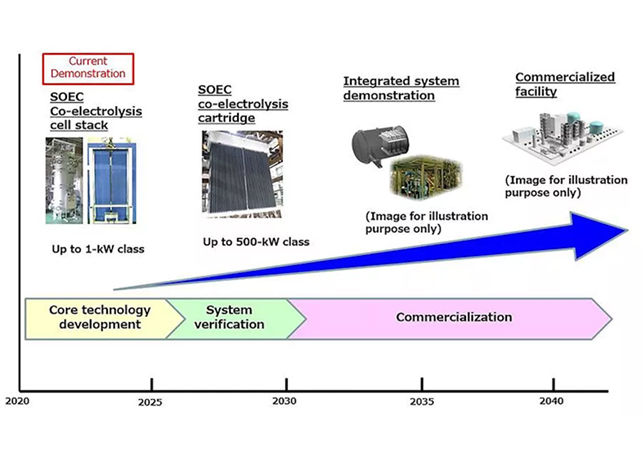
Mitsubishi Heavy Industries (MHI) has demonstrated an integrated production system for creating liquid synthetic fuels from carbon dioxide, water, and electricity at its Research & Innovation Center in Nagasaki.
The process uses Solid Oxide Electrolysis Cell (SOEC) co-electrolysis to simultaneously produce hydrogen and carbon monoxide, which serve as feedstock for Fischer-Tropsch (FT) synthesis, generating liquid fuels. Chemical analysis confirmed that the produced fuel contains components suitable for sustainable aviation fuel (SAF).
MHI’s proprietary tubular SOEC cell stack enhances co-electrolysis efficiency, simplifying the process and improving economic feasibility, supporting cost-competitive synthetic fuel production.
With the International Civil Aviation Organisation targeting net-zero carbon emissions for international aviation by 2050, SAF demand is expected to rise sharply.
MHI aims to deliver high-value SAF production systems combining SOEC co-electrolysis with FT synthesis to meet this demand.
Beyond SAF, hydrogen and carbon monoxide produced via SOEC co-electrolysis can also be converted into carbon-neutral fuels for automobiles, ships (gasoline, diesel, methanol, methane), and city gas, demonstrating broad applicability for decarbonisation.
This versatility positions co-electrolysis as a promising technology for achieving carbon neutrality across multiple sectors.
MHI plans to leverage insights from this demonstration to accelerate development and deployment of decarbonisation technologies, contributing to a sustainable, carbon-neutral world.
By integrating SOEC co-electrolysis with established FT synthesis, MHI aims to provide economically viable and scalable solutions for synthetic fuels, supporting the global transition to low-carbon energy and enabling sustainable aviation, transport, and energy systems worldwide.