

































 CO2 conversion technologies can play a critical role in mitigating climate change
AI and ML accelerate catalyst discovery and optimise conversion processes transforming CO2 utilisation from experimental concept to scalable industrial reality, researchers find out
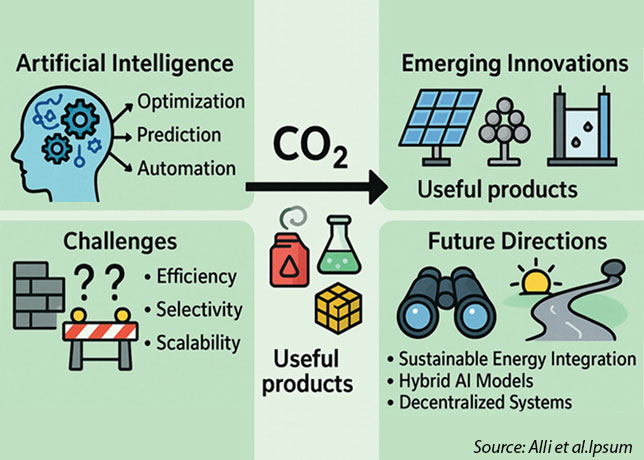
Artificial intelligence (AI) has emerged as the critical enabler for advancing carbon capture (CC) and conversion technologies from laboratory curiosities to commercially viable climate solutions, fundamentally reshaping how researchers design catalysts, optimise processes, and predict economic feasibility across the entire value chain from atmospheric capture to industrial integration.
The transformation encompasses every stage of CO2 utilisation, from enhancing capture materials and pre-treatment processes to revolutionising catalyst design across thermochemical, electrochemical, photochemical, and biological conversion pathways, whilst simultaneously enabling sophisticated techno-economic analyses that guide investment decisions and policy frameworks.
Yakubu Adekunle Alli and his co-researchers have documented in their review, titled ‘Perspectives on the status and future of sustainable CO2 conversion processes and their implementation’ that AI is crucial for accelerated transition towards carbon-neutrality and that several attempts are already being made to use it to identify research gaps, improve and discover new catalysts covering aspects such as the active materials, performance and lifecycle; optimise CO2 conversion reaction pathways, reactors and processes to obtain specific products.'
They said machine learning (ML) algorithms coupled with computational methods including density functional theory have fundamentally accelerated the discovery and optimisation of high-performance capture materials, enabling researchers to screen vast chemical spaces for metal-organic frameworks, covalent organic frameworks, porous organic polymers, and amine-based sorbents with unprecedented efficiency.
The computational approach allows prediction of thermodynamic and electronic properties before expensive synthesis and testing, with AI models successfully identifying optimal pore structures, surface functionalities, and binding site configurations that maximise CO2 selectivity whilst minimising regeneration energy requirements.
 |
AI will accelerate CO2 conversion technologies to achieve commercial viability and widespread deployment |
For metal organic frameworks (MOFs), ML has guided the development of variants including zeolitic imidazolate frameworks (ZIFs) and UiO-66 with enhanced thermal and chemical stability, lower regeneration energy requirements, and improved selectivity, addressing critical barriers to industrial deployment through rational design rather than empirical experimentation.
In pre-treatment processes, AI optimisation has refined pressure swing adsorption and temperature swing adsorption systems, with algorithms determining optimal operating conditions that match specific material properties and conversion goals, resulting in more energy-efficient cycles that enhance overall system performance.
The integration of capture with conversion represents a particularly promising application of AI-driven optimisation, where ML models identify conditions for seamless processing that reduces energy consumption and operational costs by eliminating separate CO2 capture and conversion steps.
ADVANCING THERMOCHEMICAL CONVERSION EFFICIENCY
Artificial neural networks (ANN) have achieved remarkable success predicting CO2 conversion and selectivity for thermochemical processes, with models demonstrating R² values exceeding 0.95 for methanol synthesis from CO2 hydrogenation, enabling researchers to optimise catalyst composition, operating conditions, and reactor configurations before experimental validation.
Random forest models applied to catalytic CO2 methanation have successfully predicted conversion rates with training and testing root mean square errors of 6.4 and 12.7 respectively, validated through comparison with experimental literature profiles that confirm model reliability for guiding industrial-scale development.
ML frameworks have identified optimal bimetallic catalyst combinations, revealing that nickel atoms surrounded by gallium atoms provide superior active sites for CO2 conversion, a discovery that would have required extensive experimental campaigns without computational guidance.
For copper-based catalysts in methanol synthesis, gradient boosted regression trees (GBRT) and ANN achieved predictive accuracy within 1-2 per cent of experimental results, with algorithms incorporating parameters including temperature, pressure, space velocity, catalyst composition, and synthesis methods to generate comprehensive performance predictions.
The computational efficiency of these approaches proves particularly valuable given that traditional catalyst development requires months or years of iterative experimentation, whereas AI-guided screening can evaluate thousands of candidate materials within days or weeks.
ELECTROCHEMICAL & PHOTOCHEMICAL SYSTEM OPTIMISATION
ML-genetic algorithms have optimised electrochemical CO2 reduction systems by systematically varying electrode preparation parameters, with extreme gradient boosting regression algorithms achieving predictions only 2.34 per cent different from experimental results, demonstrating practical applicability for industrial process development.
Density functional theory coupled with active learning has identified copper-aluminium catalysts with enhanced efficiency for reducing CO2 to ethylene, achieving the highest Faradaic efficiency reported through computational screening that evaluated multiple sites and surface orientations for optimal CO binding.
For photoelectrochemical systems, ML models employing ANN have predicted gas-phase CO2 photoconversion rates with outstanding performance metrics, showing predicted conversion at 71.32 per cent compared to experimental results of 70.6 per cent, validating the approach for photocatalyst development.
The integration extends to continuous-flow photoelectrochemical reactors, where AI optimisation has achieved thirty-fold increases in CO Faradaic efficiency and sixteen-fold increases in production rates compared to traditional batch systems, demonstrating substantial performance improvements through intelligent process design.
BIOLOGICAL PATHWAYS & INDUSTRIAL INTEGRATION
ML approaches have begun revolutionising biological CO2 conversion by optimising metabolic pathways, identifying genetic modifications that enhance carbon fixation rates, and predicting enzyme performance across varying environmental conditions, though this application area remains less developed than thermochemical and electrochemical systems.
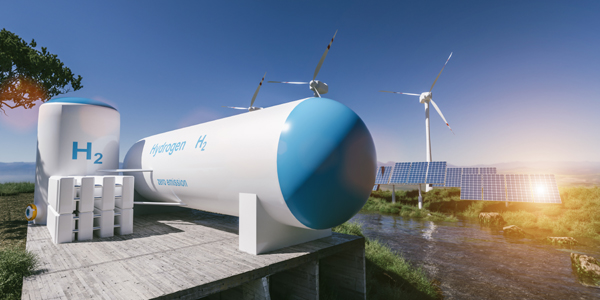
The integration of CO2 conversion with renewable energy systems represents a critical application domain for AI optimisation, where algorithms balance intermittent solar and wind power availability with continuous conversion process requirements, maximising capacity factors whilst minimising energy storage costs.
For industrial integration, ML models evaluate multiple scenarios including different CO2 sources, conversion pathways, and product distributions, with analyses revealing that reducing hydrogen prices below $900 per tonne and lowering operating costs to 5-6 per cent of current levels proves critical for economic viability.
AI-driven techno-economic analyses have demonstrated that CO2-to-methanol processes could achieve levelised costs of $3.51 per gallon of gasoline equivalent with current technology, potentially reducing to $2.25-2.53 per gallon with technological improvements and electricity costs of $0.01 per kilowatt-hour.
Comprehensive ML frameworks coupling process models with experimental assessments have established generic approaches for predicting methanol space-time yields across various catalyst types, providing investors and policymakers with reliable projections for commercial deployment decisions.
ADDRESSING IMPLEMENTATION CHALLENGES
Despite remarkable progress, significant gaps remain in applying cutting-edge AI techniques including self-supervised learning, deep generative models, and large language models to CO2 conversion, with urgent needs for comprehensive databases and standardised implementation protocols.
Data scarcity presents a critical barrier, particularly for emerging biological and photoelectrochemical systems where experimental information remains limited compared to more mature thermochemical and electrochemical technologies, necessitating strategies for effective learning from small datasets.
Model interpretability requires improvement, especially for revealing reaction mechanisms and informing rational catalyst design, as the heavy reliance on descriptor-performance relationships poses limitations when extrapolating to novel systems with new variables or unexplored operating conditions.
The field exhibits discernible bias toward carbon capture and storage (CCS) applications compared to utilisation pathways, largely attributable to more mature industrial development and greater data availability, suggesting opportunities for accelerated progress through targeted data generation initiatives.
Hybrid approaches combining conditional generative models with ML simulations, or integrating computational predictions with experimental validation, have emerged as effective strategies for overcoming current limitations whilst maintaining rigorous scientific standards.
FUTURE TRAJECTORIES & STRATEGIC PRIORITIES
Establishing standardised benchmarks and methodologies represents an urgent priority for guiding AI implementation and accelerating progress, with researchers emphasising needs for comprehensive evaluation metrics, detailed step-by-step protocols, and shared databases that enable reproducible research.
The integration of AI across entire research pipelines from catalyst screening through techno-economic analysis and life-cycle assessment maximises value extracted from computational investments, as demonstrated by studies that simultaneously predicted conversion efficiency, product selectivity, and environmental impact.
Advanced ML models will increasingly incorporate considerations of catalyst stability, long-term performance degradation, and regeneration requirements, addressing critical gaps that currently limit predictive accuracy for industrial-scale deployment over multi-year operating periods.
The convergence of AI with emerging technologies including additive manufacturing for catalyst fabrication, high-throughput robotic experimentation, and real-time process monitoring through digital twins promises to accelerate development cycles from years to months.
GBRT and ANN have emerged as preferred algorithms across diverse applications, though optimal choices depend on specific requirements, available data quality and quantity, and computational resources, with ongoing research exploring ensemble approaches that combine multiple model types.
The transformation of CO2 conversion through artificial intelligence extends beyond technical optimisation to encompass strategic planning, with ML models evaluating network designs for CO2 conversion facilities, optimal locations considering electricity costs and CO2 sources, and integration with existing industrial infrastructure.
AI-driven life cycle assessments have revealed that energy sources for CO2 capture and conversion dominate environmental impacts, with models demonstrating that renewable electricity integration proves essential for net-negative emissions, guiding infrastructure investment decisions toward sustainable configurations.
The future trajectory points toward increasingly sophisticated integration of AI throughout the CO2 conversion value chain, from molecular-level catalyst design through reactor engineering to economic modelling and policy analysis, establishing computational intelligence as an indispensable tool for achieving global decarbonisation objectives.
As computational power increases and datasets expand through coordinated international research efforts, the role of AI in accelerating CO2 conversion technologies will intensify, transforming these approaches from supportive tools to central drivers of innovation that determine which pathways achieve commercial viability and widespread deployment.