





























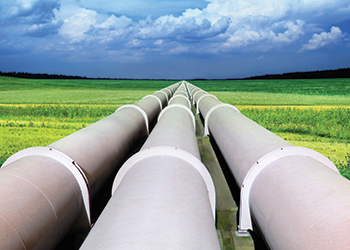
 The onshore pipeline construction market is fairly insulated
Douglas-Westwood (DW) expects onshore pipeline capital expenditure to grow modestly to $220 billion between 2015 and 2019, according to the latest edition of the World Onshore Pipelines Market Forecast
A substantial fall in oil prices since July 2014 has negatively impacted the onshore pipeline market, although project delays are almost exclusively in North America. The pipeline market itself is well-cushioned from short-term commodity price fluctuations with projects typically responsive to long-term demand and supply trends, both within and between regions, says the eighth edition of the World Onshore Pipelines market forecast 2015-2019 from Douglas-Westwood.
Douglas-Westwood (DW) expects onshore pipeline expenditure to grow modestly to $220 billion between 2015 and 2019, an increase of 14 per cent compared with $193 billion over the preceding five-year period. An increasing volume of pipeline installations is expected in most regions, supported by continued product demand growth in both new and existing population centres, new and increasing hydrocarbon supply, and a shift in energy demand preferences towards gas.
Author, Matt Loffman, comments: "This represents a 14 per cent increase on the previous five-year period. The substantial fall in oil prices has weakened the onshore market, causing project delays and a focus on reducing costs for pipeline owners. Despite this, the delays we have observed have a different complexion to other oilfield sectors and have been limited in large part to the North America region.
"In general, the onshore pipeline construction market is fairly insulated from commodity price fluctuations when taking a global perspective. There are delays relating to a reduction in the rate of growth in major non-OECD economies in addition to falling US unconventional production figures. However these are offset to a large extent by major transmission lines and demand growth in the Middle East and Latin America."
Research team leader, Hannah Lewendon, concludes: "The team has performed a full refresh of the market model with the latest DW data. The methodology has been revised and sense-checked through extensive consultation with industry in each global region. On a regional basis the Middle East continues to be a bright spot where solid growth is anticipated. As other developing regions increase their infrastructure footprint we expect pipeline construction to remain important.
"Other observable trends include a shifting towards large diameter lines over the past three years. This is expected to continue to 2016 but in 2017 and beyond, smaller diameter pipelines are expected to gain relative market share driven by maturing networks within population centres of non-OECD countries and a return of US onshore production growth. Investment in LNG infrastructure and a move towards gas as a power source is also a key factor in future pipeline construction. We anticipate 66 per cent of installed lines between now and 2019 to transport natural gas."
North America and Asia remain the highest volume markets, together accounting for approximately 45 per cent of global capex. However, fastest growth is anticipated in the Middle East. In total DW expects almost 309,000 km of line pipe to be installed. This represents an increase of 11 per cent compared to the previous five-year period.
Now in its eighth edition, the World Onshore Pipelines Market Forecast 2015-2019 from Douglas-Westwood, considers the prospects for the onshore pipelines construction business and values the future markets through to 2019 by key component, region, pipeline type and diameter.
KEY TRENDS
With an anticipated 35 per cent increase in global energy demand between 2010 and 2040, natural gas is expected to significantly increase its share of the energy mix – growing by 65 per cent over the same period. This trend, observable in our previous edition of this report, is progressing as expected, driven in large part by non-OECD demand growth and technology advancements, including in liquefied natural gas (LNG).
Investment in new infrastructure to support LNG and unconventional gas developments will be a major factor shaping future demand for pipelines. Outside the major oil province of the Middle East, gas pipelines accounted for 62 per cent of km installed over the past five years with this figure expected to increase to 66 per cent for the 2015-19 period.
"We have seen lower steel prices and greater manufacturing capacity become available. Lower levels of near-term activity among tubular goods providers have released manufacturing capacity for line pipes. Lower than expected economic growth in Asia and reduced activity in North American unconventional production is expected to support this scenario in the short-term," the DW report says.
Visiongain’s extensive report reveals that onshore oil and gas pipeline infrastructure will experience a capital expenditure of $61.8 billion in 2015.
Oil and gas pipelines are an essential part of hydrocarbon transportation and distribution, and are required to ensure the smooth operation of the energy industry. The market is currently experiencing a number of important changes, with strong economic and population growth in some developing countries – most notably China and India – necessitating an expansion of pipeline infrastructure. On the other hand, the more established North American region is experiencing a renaissance in domestic production, which is leading to investments in pipeline projects.
PROCESSING & SERVICES MARKET
 |
Pipeline processing and services … an increasing market |
According to a Transparency Market Research report on the global pipeline processing and pipeline services market, pipelines is an important and affordable medium to transport various kinds of products such as crude oil, petroleum products, refined petroleum products, natural gas, liquid petroleum gas, chemicals and water among others from drilling and production sites to the storage terminals and end-users. Generally, these pipelines are buried under the ground at a depth of one to two metres. Pipelines are usually made from steel, plastic tubes or carbon steel. Diameter of these tubes vary from two inches to 60 inches. Pipelines have to be inspected, maintained, serviced, and protected periodically to prevent corrosion, abrasion, dents, cracks, and wax buildup.
These maintenance and troubleshooting activities are termed as pipeline processing and pipeline services. Pipeline processing includes activities such as chemical cleaning, leak detection, controlled bolting, hot oil flushing, pipe freezing, foam inverting, hot tapping, and leak metering among others. Pipeline servicing includes activities such as pipeline cleaning, pipeline gauging, filling and flooding, dewatering, vacuum drying, testing services, and nitrogen purging among others.
The market for pipeline processing and pipeline services is increasing steadily it was first started in the late 19th century. Pipelines are generally the most economical way to transport large quantities of oil, gas, chemicals and water over land. The total length of pipelines constructed for transportation across the globe is approximately 3,800,000 kms as of 2014. Much more pipeline projects are in planning stage and under construction currently. The market for pipeline processing and pipeline services has matured and has been growing constantly due to increasing pipeline construction activities across the globe.
The global pipeline processing and pipeline services market can be segmented on the basis of processes, services, applications/deployment and geography. The pipeline processing includes chemical cleaning, leak detection, controlled bolting, hot oil flushing, pipe freezing, foam inverting, hot tapping, and leak metering among others. Pipeline services include pipeline cleaning, pipeline gauging, filling and flooding, dewatering, vacuum drying, testing services, and nitrogen purging among others. All these processes and services are carried out to clean pipes, remove slag, remove wax, detect cracks or corrosions and remove any other anomalies for efficient and optimal operations of pipelines over a long period. Pipeline processing and pipeline services are deployed for onshore as well as offshore pipelines.
North America including the US, Canada and Mexico have the highest share of pipeline processing and pipeline services market. The US alone accounts for more than 2,200,000 kms of pipelines for transportation. Hence, pipeline processing and services market in the US is very huge. Europe and Middle East including Russia, Ukraine, UK, Netherlands, Germany and Saudi Arabia also have a huge market for pipeline processing and pipeline services.
Asia Pacific holds a huge potential market for pipeline processing and pipeline services and has grown significantly in recent years. Countries such as Australia, China, India, Kazakhstan and Indonesia have given a huge boost to pipeline processing and pipeline services market. Latin America and Africa are also expected to have a decent market share in the coming decade.
Some of the major drivers for pipeline processing and pipeline services market includes the increasing demand for energy and discovery of new oil and gas reserves across the globe. In recent years, oil and gas production has increased enormously worldwide. New energy sources and advanced drilling technology will further boost the demand for pipelines. Also, shifted focus on more productive wells will boost oil and gas production, which will increase the demand for pipelines. The demand for new oil and gas pipelines will continue to rise as well as expansion and maintenance of existing pipelines is also predicted.
In recent times, many onshore oil and gas reserves have been discovered and utilised. This has given immense boost to demand for pipelines in intrastate and interstate infrastructure. Rise in construction of pipelines will directly bolster the pipeline processing and pipeline services market. Although, high initial investments and the falling prices of oil and gas across the globe may pose a threat to pipeline processing and pipeline services market. However, new natural gas and oil resources along with rise in consumption of oil and gas may prove beneficial to pipeline processing and pipeline services industry. All these factors predict a good growth trajectory for pipeline processing and pipeline services market during the forecast period.
Some of the key players in the pipeline processing and pipeline services market include Anabeeb Arabian Pipeline & Services Co, Aramco Services Company, Baker Hughes, Clock Spring, Future Pipe Industries, Halliburton, Rosen Saudi Arabia Co, and Schlumberger Pipeline Services among others.
OFFSHORE PIPELINES MARKET
 |
Oil and gas pipeline leaks are growing |
Despite the uncertainties in global oil prices, Infield Systems expects to see a healthy growth in investment within the pipelines and control lines sectors over the 2015-2019 timeframe. Rebounding from a drop in expenditure during 2015, this market is expected to grow by a CAGR of 6 per cent throughout the period, with a total of 51,797 kms of pipelines and 30,432 kms of control lines forecast to be installed globally during the timeframe. Whilst the largest investment within the pipelines sector is expected to be seen offshore Latin America, Europe is expected to account for the largest share of control line expenditure demand during the five year period to 2019.
Latin America is anticipated to see the highest levels of pipeline investment during the period of analysis. The region is projected to see a 35 per cent increase in offshore pipeline capex in comparison to the historic period which mainly relates to developments offshore Brazil, where Surf lines are the predominant pipeline type installed due to the deep and ultra deepwater nature of prospects. Control line capex in Latin America is expected to increase by 70 per cent in comparison to the historic period.
Although Europe is expected to drop to fourth place in terms of pipeline capex, the region is still expected to see a 27 per cent increase in expenditure. North West Europe will be the main source of demand and could account for 75 per cent of European pipeline expenditure up to 2019. Installation activity will be largely focused on the region’s two main offshore markets, Norway and the UK. Europe is expected to remain the primary driver of control line demand, with investment levels expected to rise significantly.
PIPELINE LEAK DETECTION MARKET $1.8BN
Investments in pipeline infrastructure and stringent regulatory norms pertaining to oil and gas pipeline leak detection to drive global oil and gas pipeline leak detection market
According to recently published TechSci Research report "Global Oil & Gas Pipeline Leak Detection Market Forecast & Opportunities, 2020", global oil and gas pipeline leak detection market is projected to cross $1.8 billion in 2020. Growth of oil and gas pipeline leak detection market is directly affected by the oil and gas pipeline network, and the market is expected to witness growth over the next five years on account of increasing investments in oil and gas pipeline infrastructure, especially in Africa and Europe.
Apart from being deployed in new pipelines, leak detection systems are increasingly being used in ageing pipelines. Ageing pipelines, being more prone to corrosion, possess greater risk of leakage, and thus demand use of better leak detection systems. On account of strict regulations and high compensations in case of hydrocarbon spills, ageing pipelines are propelling demand for pipeline leak detection systems across the globe.
"Globally, the incidents of oil and gas pipeline leaks have witnessed a steady rise over the last decade. Oil and gas pipeline leaks adversely affect not only the environment, but also the finances of the companies, which are liable to pay hefty amounts for such incidents in the form of damages and compensation. In view of the after effects of oil and gas pipeline leakages, governments of various countries have formulated regulations and guidelines which have made deployment and maintenance of leak detection systems mandatory, thereby fueling growth in oil and gas pipeline leak detection market," says Karan Chechi, research director of TechSci Research, a research based global management consulting firm.
PIPELINE SAFETY MARKET – $6.73BN BY 2018
Meanwhile, pipeline safety market is projected to be worth $6.73 billion by 2018, as per a report by MarketsandMarkets. The report has segmented the global pipeline safety market based on the type of deployment i.e. onshore and offshore; the type of product transported through them i.e. natural gas, crude oil, refined products and chemicals, water and others (HVDC, communication); by the technologies and solutions deployed for infrastructure security; by professional services offered; and by regions i.e. North America (NA), Asia Pacific (APAC), Europe (EU), Middle East and Africa (MEA) and Latin America (LA).
Increasing demand for oil and natural gas and competitive pricing has forced the government and private players across nations to deploy cheaper and efficient means of transportation. The increase in terrorist attacks and cyber-crime on energy sector has also forced the government to set up regulatory policies and security compliances to ensure the safety of the people and environment.
The absence of integrated platforms offering both physical and network security solutions, has forced the pipeline operators to deploy multiple security solutions available in the market such as Supervisory Control and Data Acquisition (Scada) network security solutions, surveillance solutions using unmanned aerial/underwater vehicles, leakage detection solutions and pigging systems to improve their operational efficiency. Major companies are now providing dedicated integrated security platforms to gain traction in this highly fragmented market.
The major forces driving this market are the increased government pressure and security compliance and regulations, threats from terrorist attacks and cyber-attacks, lack in comprehensive solution for pipeline safety and physical attacks and insider threats. Companies providing physical security solution and cyber security solutions are looking forward to gain a better competitive advantage in this growing market, thereby creating comprehensive security solutions and integrated security management platforms for the rig platforms and refineries.
The global pipeline safety market was estimated to be $4.35 billion in 2013 and is expected to grow to $6.73 billion in 2018. This represents an estimated compound annual growth rate (CAGR) of 9.1 per cent from 2013 to 2018. In the current scenario, the natural gas pipelines continue to be the largest segment, in terms of spending and adoption, for pipeline safety solutions, followed by oil and chemical refined products.
In terms of regions, North America is expected to be the biggest market on the basis of spending and adoption for pipeline safety solutions. MarketsandMarkets further expects that the increasing energy markets in the developing economies and increased extraction and distribution infrastructure will further enhance the growth of the market.
.jpg)