
































































 Andre Correa do Lago, COP30 President, gets emotional during the closing of COP30. Photo by Ueslei Marcelino
The Belem summit delivered a minimal foundation for action, far too slow and weak to match the climate crisis urgency, confirming the persistent chasm between ambition and real emission cuts The COP30 climate summit in Belem, Brazil, concluded with a voluntary plan to curb fossil fuels, a goal to triple adaptation finance and new efforts to strengthen climate targets, falling short of what many climate-vulnerable nations had demanded.
After all-night negotiations in the Amazonian city, the Brazilian presidency released a final package termed the 'global mutirao', meaning 'collective efforts', which drew together controversial issues that had divided the fortnight of talks.
A mechanism to help ensure a just transition globally and a set of measures to track climate-adaptation efforts were among COP30’s notable outcomes.
COP, or Conference of the Parties, is the supreme decision-making body of the United Nations Framework Convention on Climate Change (UNFCCC), an international treaty adopted in 1992 to combat climate change.
It brings together representatives from nearly 200 countries (the 'Parties') annually to assess progress, negotiate new commitments, and adopt legal instruments aimed at reducing greenhouse gas emissions and adapting to climate impacts.
The most famous outcomes include the Kyoto Protocol (COP3, 1997) and the Paris Agreement (COP21, 2015).
COP30 saw 56,000 registered delegates attend the summit in Belem.
ADAPTATION FINANCE FALLS SHORT OF AMBITIOUS TARGETS
The key global mutirao decision calls for efforts to triple adaptation finance by 2035.
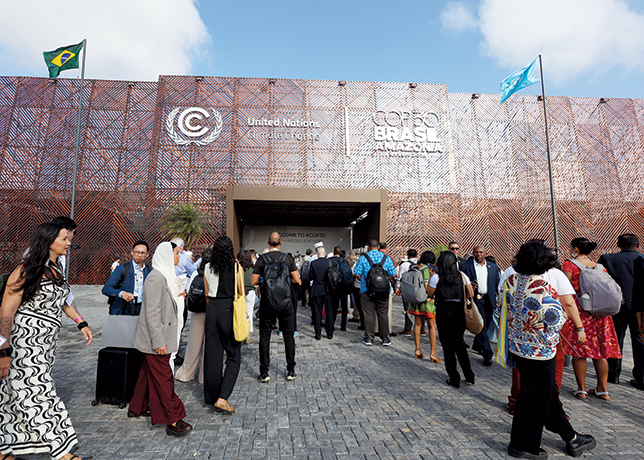 |
The COP30 venue in Belem, Brazil |
This followed a request from least-developed countries for a target to triple adaptation finance to $120 billion by 2030.
In 2021, a target to double adaptation finance to $40 billion by 2025 was agreed at COP26 in Glasgow.
However, in 2023, developed nations provided just $26 billion in adaptation finance to developing nations, marking a drop from $28 billion in 2022 and far short of the annual adaptation-finance needs for these nations, which United Nations Environment Programme (UNEP) puts at around $310 billion annually out to 2035.
The mutirao text reaffirmed the doubling goal from Glasgow, called for efforts to triple adaptation finance and urged developed countries to increase the trajectory of their finance provisions.
However, the deadline for the tripling target was pushed back by five years and the reference to 2025 as the baseline for this goal was removed.
With no baseline officially in the text, the Standing Committee on Finance could provide a space where the baseline is defined by parties.
The COP30 outcome included adoption of 59 indicators for tracking adaptation progress under the global goal on adaptation, substantially reduced from the 100 indicators that had been proposed by experts.
The text also contained plans for a two-year 'Belem-Addis vision' to further refine the indicators.
AMBITION & TEMPERATURE GOALS REMAIN ELUSIVE
The global mutirao decision aims to keep the limit of 1.5 deg C 'within reach', but says that the carbon budget for this is 'now small and being rapidly depleted'.
For the first time in a COP text, it also acknowledges that there is likely to be an overshoot of 1.5 deg C, saying that both the extent and duration of this needs to be limited.
It responds to this by launching two voluntary initiatives, led by the COP presidencies: a 'global implementation accelerator' and a 'Belem mission to 1.5 deg C'.
Countries had arrived in Brazil as a series of reports made clear that they remained badly off track for limiting warming to 1.5 deg C.
Despite countries submitting more than 100 new climate plans, known as nationally determined contributions, the world remains on track for 2.3-2.5 deg C of warming by 2100.
The decision does not mention fossil fuels or a mooted roadmap to transition away from their use.
In the closing plenary, the EU called the decision a 'missed opportunity'.
CLIMATE FINANCE WORK PROGRAMME ESTABLISHED
Finance to help developing countries deal with climate change influenced much of the event.
An effort by India, Arab states and other developing countries to elevate the issue ended up forming part of the Belem summit’s core mutirao package.
The package launched a new work programme for countries to discuss concerns about climate finance.
Some developing countries argued that a new $300 billion-a-year goal agreed at COP29, covering both funds provided and climate finance from a wide variety of sources, would enable developed countries to meet the goal without raising their contributions much.
Ahead of COP30, the like-minded developing countries and Arab group called for a three-year work programme on implementing Article 9.1 of the Paris Agreement, which says developed countries 'shall provide' climate finance through public money.
The mutirao text contains the compromise of a two-year programme covering all of Article 9 and a footnote stating the decision does not prejudge implementation of the new collective quantified goal.
UNILATERAL TRADE MEASURES SPARK FORMAL DIALOGUE
After several failed attempts to bring climate-related unilateral trade measures onto the agenda at previous COPs, the issue was taken up in Belem.
The global mutirao decision creates three annual dialogues on trade, to be held at the Bonn meetings in 2026, 2027 and 2028.
It also reaffirms that climate measures, including unilateral ones, should not constitute trade restrictions that are arbitrary or discriminatory.
This is the first-ever mention of trade measures in a COP cover decision.
In Belem, the like-minded developing countries called for a recurring agenda item on trade.
There was a particular focus on the EU’s carbon border adjustment mechanism, with a draft text noting with concern its potential impact, though this language was removed from the final decision.
JUST TRANSITION MECHANISM CELEBRATED AS VICTORY
The outcome of the just transition work programme at COP30 has been hailed by many in civil society as a victory, thanks to the adoption of a new institutional mechanism.
Over the course of the two weeks, organisations published an open letter calling for the creation of the mechanism, numerous actions took place within the corridors of COP, and banners bearing the 'BAM!' logo were carried during the people’s protest.
On the second day of negotiations, the G77 plus China put forward a proposal for a just transition mechanism, which would provide technical assistance, international cooperation and help foster partnerships.
Norway, the UK and others opposed the creation of a mechanism, arguing it would duplicate existing systems, take at least five years to set up and citing a lack of funding.
By the end of the summit, negotiations were able to converge on the idea of establishing a just transition mechanism, as set out in the final text.
The final text included language on the meaningful participation of a range of groups, including, for the first time, people of African descent.
The creation of an institutional mechanism around just transition saw the adoption of this text being greeted by extended applause in the COP30 closing plenary.
LOSS & DAMAGE FUND MAKES LIMITED PROGRESS
Loss and damage negotiators managed to agree on a number of texts, including a review that has proved difficult to wrap up over the past year.
At a week-one COP30 event, the fund for responding to loss and damage launched its first-ever call for funding requests.
So far, mostly developed countries have collectively pledged $790 million to the fund, but only $397 million of this has been paid into the fund.
The initial round will distribute $250 million of grants over the next six months to nations in need of support.
The figures being discussed are a fraction of developing countries’ annual needs, which are in the hundreds of billions of dollars.
CLIMATE SCIENCE FACES RESISTANCE
Bangladesh, the EU and the UK were among those left disappointed by COP30 conclusions on climate science.
The text on research and systematic observation failed to endorse the Intergovernmental Panel on Climate Change as the 'best available science'.
It noted the need for the integrity of climate change information, but made no mention of the need to counter misinformation on climate change.
The text also failed to mention the latest findings on the state of the climate, as presented to the summit by the IPCC, the World Meteorological Organisation and others.
According to the Earth Negotiations Bulletin, the Arab group and India opposed references to the Intergovernmental Panel on Climate Change (IPCC) and to specific findings from the World Meteorological Organisation (WMO).
Several sources tell Carbon Brief that COP discussions on climate science have been getting harder and more political.
COP30 was also unable to agree on asking the IPCC to align its seventh assessment cycle with the second global stocktake under the Paris Agreement, due in 2028.
SUMMIT CONCLUDES AFTER ALL-NIGHT NEGOTIATIONS
COP30 officially finished at 8:44pm on Saturday, November 22 evening, making it only the 11th longest climate talks in history.
In total, there were more than 150 pages of decision text adopted across the various bodies meeting at the COP.
After brief applause, Andre Correa do Lago, COP30 President, acknowledged that some countries were hoping for more ambitious outcomes from the text.
He then announced that the COP30 presidency would bring forward two roadmaps, on transitioning away from fossil fuels and deforestation, to present at the next COP, which will be hosted by Turkiye, with Australia appointed as President of the negotiations.
The fossil-fuel roadmap will be guided by an upcoming conference on transitioning away from fossil fuels hosted by Colombia and the Netherlands in April.