


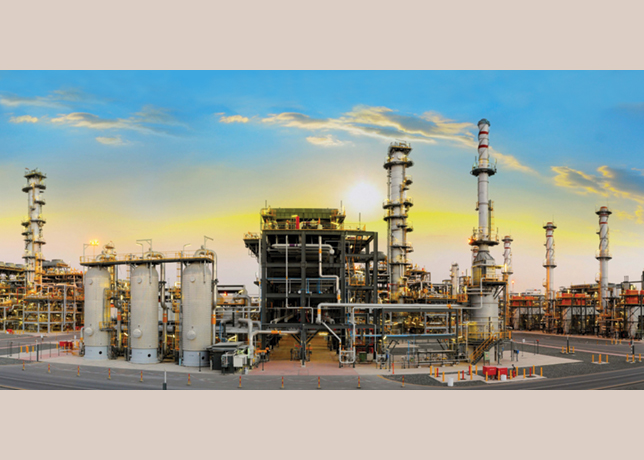




The two cities were launched by the Royal Commission for Jubail and Yanbu to provide top quality, purpose-built and a highly efficient environment for industrial development.
Jubail is located near the Arabian Gulf while Yanbu is near the Red Sea.
Custodian of the Two Holy Mosques King Abdullah bin Abdulaziz laid the foundation stone for Jubail-II, which is expected to draw in investments worth SR224 billion ($300 billion) and create some 55,000 new jobs.
The new industrial city is situated about three km to the west of Jubail-I.
The Royal Commission will provide all the infrastructure, including roads, utilities, gas, electricity, sea water cooling, potable water, waste water treatment, feed-stock and a product pipeline corridor to King Fahd Industrial Port.
Jubail-II is aimed at capitalising on the country’’s abundant hydrocarbon resources, to optimise economic and social benefits for the Kingdom and to further strengthen an already globally competitive petrochemical industry.
The first three projects to be implemented at the two new industrial cities in Jubail and Yanbu involve a capital investment of SR45.35 billion, according to Prince Saud bin Abdullah bin Thunayan Al Saud, Chairman of the Royal Commission, which has made land allocations to start work on the projects.
He said an oil refinery will be established in Jubail-II by Saudi Aramco in association with French oil company Total SA on a five million square metres of land at a cost of SR24 billion.
The refinery will have a daily capacity of 400,000 barrels and will create 1,000 jobs.
The Jubail refinery will manufacture basic petrochemical products, such as benzene, liquidate gas and propylene.
Aramco and Total signed a deal for the project in May last year. Prince Saud said the second location in Jubail-II will go to Sipchem Olefins, one of the major petrochemical projects with an investment of SR20 billion, adding that the plant would create 1,880 new jobs and supply 20 petrochemical products.
The project includes 1.2 million tonnes per year of ethane/propane cracker, a bimodal HDPE, PP, vinyl acetate and polyacrylonitrile.
The third project, a petrochemical plant, will be established in Yanbu-II at a cost of SR1.35 billion, Prince Saud said.
It will cover 200,000 square metres in the new industrial city on the Red Sea coast.
He said the Royal Commission was able to complete infrastructure facilities at the two giant industrial cities within a short span of nine months.
“There is growing demand for space at the two cities from industrialists,” he pointed out.
Meanwhile, Sabic said an affiliate, National Industrial Gases Company, had signed a 1.5 billion riyal ($400 million) Islamic loan to fund an expansion project.
Banque Saudi Fransi led a consortium of eight Saudi and Arab banks, including Samba Financial Group, for the murabaha facility, Sabic said.
The loan will help finance expansion projects of National Industrial Gases Company, which wants to increase the production capacity of oxygen to 19,000 tonnes per day and nitrogen to 9,750 tonnes per day, Sabic said.
Sabic posted a record quarterly profit, up 50 per cent on last year and beating analyst forecasts on higher prices and output.
Its net income in the three months to March 31 rose to SR6.3 billion, or 2.51 riyals per share, compared with 4.18 billion or 1.67 riyals per share a year earlier, the state-controlled company said.
“The most significant improvement affected prices of polymers, steel and fertilisers,” Vice Chairman and CEO Mohamed Al-Mady said. “Prices of other products, such as plastics, rose as well.”
The price of Sabic’s main products climbed 14 per cent compared with the first quarter of 2006 and production and sales rose 11 per cent, the company said.
Sabic has said it plans to nearly double its production to 100 million tonnes by 2015 by building plants in China, India and Saudi Arabia, and making acquisitions in the United States and Europe.
The company’s development plan will make it one of world’s top three chemical producers by 2020, Al-Mady told a meeting of shareholders, according two investors who were present.
The company aimed to have revenues of 225 billion riyals by then, a 160 per cent increase on the 2006 figure, the shareholders said.
A senior Sabic executive confirmed the 2020 revenue target.
In another development, Foster Wheeler Ltd announced that its subsidiary Foster Wheeler USA Corporation, part of its Global Engineering and Construction Group, has been awarded a contract by Aramco Services Company and Total France for a process design package for a new delayed coker.
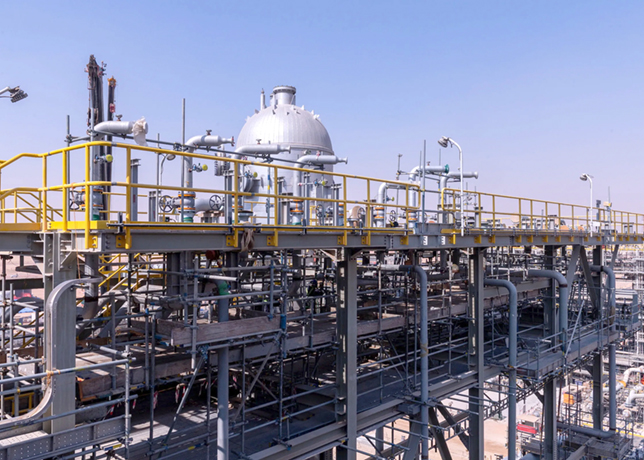
The delayed coker is part of the Jubail Export Refinery, a grassroots full-conversion refinery designed to process Arabian heavy crude, to be built in Jubail Industrial City.
The delayed coker unit, one of the largest in the world, will be based on Foster Wheeler’s leading Selective Yield Delayed Coking SYDEC(SM) process.
The coker design package will be developed by Foster Wheeler’s Houston, Texas, office.
Fluor Corporation announced that it was selected to provide engineering, procurement, construction management and precommissioning services to Saudi International Petrochemical Co Ltd for an acetyls complex in Jubail.
The billion-dollar contract was booked in first quarter 2007. The project scope includes the main plant, which will manufacture acetic acid and vinyl acetate monomer, a high-end specialty plastic for clients, and a new Utilities plant.
Methanol Chemicals Company Ltd (Chemanol) announced its new expansion SR 1.5 billion ($400 million) plan in Jubail city.
The plan signals a growth into new downstream methanol based products. It also includes the creation of a captive methanol production capability.
Meanhwile, Saudi Arabia’s Public Investment Fund (PIF) has granted Kayan Petrochemical Co a SR4 billion ($1.1 billion) loan to help finance an industrial complex, Kayan’s chief executive said.
Sabic, which owns a stake in Kayan, is helping set up the $10 billion project with Kayan in Jubail. Government-owned PIF’s loan is part of the $6 billion that Sabic said last year would be raised to finance the Kayan project. The rest of the financing is being arranged, CEO Mutlaq Al-Morished said.
With an annual production capacity of more than four million tonnes, the complex will produce ethylene, propylene and other chemicals mainly for export to Asian nations such as China and India. It will be complete in 2009.
Kayan raised 6.75 billion riyals in an initial public offering.
Al-Morished, who is also Chairman of Yanbu National Petrochemical Company (Yansab) and Sabic Vice President, Corporate Finance received in Bahrain the ‘2006 Middle East Petrochemicals Deal of the Year’ award from the Euromoney Magazine.
Al-Morished said, “We completed many other projects successfully in 2006. However, the Yansab project financing of SR13.125 billion (US$3.5 billion) stood out for a number of reasons.”
Yansab is the first company to have successfully closed an initial pubic offering at the inception stage in Saudi Arabia.
The IPO for SR1.969 billion ($525 million) was closed before the debt financing. The Yansab IPO was also awarded “IPO of the Year” by the Banker’s Magazine.
In another development, General Electric Co said it would sell its GE Plastics business to Sabic in an $11.6 billion cash deal.
Standard and Poor’s Ratings Services announced that it has affirmed its ‘A+/A-1’ long- and short-term foreign currency corporate credit ratings on Sabic and its ‘BBB/A-2’ corporate credit ratings on its European subsidiary Sabic Europe B V.
“The outlook is stable,” the ratings agency said.
This follows the company’s announcement that it will acquire the plastics business of US based General Electric Co (AAA/Stable/A-1+) for a total of $11.6 billion.
South Korean companies are looking to participate in Saudi Arabia’s Jubail and Yanbu refinery projects worth $12 billion, the Ministry of Commerce, Industry and Energy said.
Saudi Arabian Fertilizers Co’s (Safco) first-quarter net profit rose 16 per cent on higher production and prices, the company said.
Indian engineering and construction company Punj Lloyd Ltd said it has signed a letter of intent with Saudi Kayan Petrochemical Co.
Shaw Group Inc’s Shaw Stone & Webster business unit signed two letters of intent to provide proprietary furnace equipment and professional services to Arabian Petrochemical Co, or Petrokemya, an affiliate of Sabic.
The 400,000 barrel per day export-oriented refinery planned by Saudi Aramco and France’s Total will cost $6.4 billion, the state news agency SPA said, up seven per cent from previous projections.
Aramco also agreed last year with US ConocoPhillips on a 400,000 bpd refinery in Yanbu it has estimated would cost $6 billion.
Sabic said it opened two new offices in China to strengthen its position in the Asian country’s fast growing plastics market.
Sabic will open the offices in Beijing and Shenzhen as part of plans to boost its presence “in the world’s most important and fastest growing polymers market,” the company said.