

















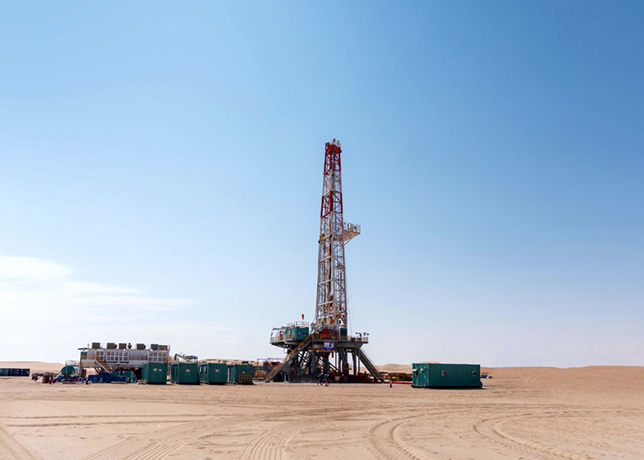


 Drilling operations set to be revolutionised by ETT technology.
Hailed as more important than horizontal drilling and as technologically significant as three-dimensional seismic surveying, is expandable tubular technology the way forward? Arran Dall reports
The idea of expandable tubular goods may sound more like magic than advanced technology, but whatever the source of the imaginative spark that led to their invention, the state-of-the-art equipment developed by the Shell Oil-Halliburton joint venture Enventure Global Technology allows operators to drill wells in a way never before possible.
The technology is called "MonoDiameter," and it represents the great potential of expandable tubular technology (ETT). The MonoDiameter allows operators to drill wells with the same internal casing diameter from the surface to total depth, executives of Shell and Enventure have been quoted as saying.
At a recent briefing with journalists in Houston, the Shell and Enventure executives compared the tubular technology's significance to that of three-dimensional (3-D) seismic surveys, and said it was more important than horizontal drilling.
"We expect this revolutionary process to do for well design what 3-D seismic did for geologic exploration and hydrocarbon development," said Restucci, president of Shell exploration and eroduction.
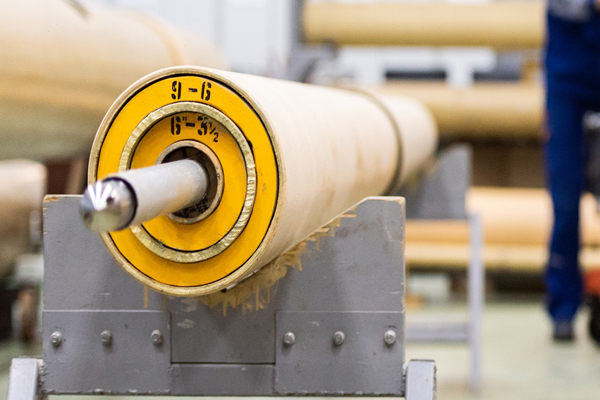
In a conventional well, the diameter of the casing that lines the borehole tapers or "telescopes" between the top and bottom. It might start at 36 inches on the surface and shrink to 5 1/2 inches at total depth of 25,000 feet, said Lance Cook, president of Enventure.
By comparison, a well that used MonoDiameter casing would have a diameter of 9 5/8 inches from top to bottom.
The "magic" comes from the unique metallurgy in the tubular goods that allows each length of pipe to be inserted through casing already in place, then expanded to the same diameter. Shell developed the concept over a 10-year period, then joined forces with Halliburton to commercialize the technology.
Though expandable casing is more expensive than standard casing, its use results in substantial savings elsewhere. For example, the same size drillbit can be used throughout. The wellbore is smaller overall, resulting in less drilling time, lower consumption of drilling mud and other fluids, lighter-weight drillstrings, and smaller blowout preventers.
Operators can use a less rugged and thereby less costly drilling rig because of the lighter weight of the drillstring, Restucci said. This is particularly significant in offshore operations, where the day rates for drilling rigs can be several hundreds of thousands of dollars.
He cited other benefits that fit with Shell's broader sustainable development philosophy. The environmental impact is reduced significantly because of a reduction of up to 75per cent in the areal footprint, and use of smaller rigs lowers emissions. Narrower-diameter wells have as much as 50 per cent fewer cuttings and require 20per cent less drilling mud, 50per cent less cement, and 55per cent less steel.
Finally, the wells can produce at higher rates because of the wider diameter at total depth. The improved revenue stream accelerates payback of the investment.
Another advantage that should contribute to lower costs and safer operations is standardization of equipment. For example, the same size drillstring and drillbits could be used from start to finish. Smaller blowout preventers also would be used. Safety would be enhanced as crews used smaller, lighter equipment in a standard size.
Shell tested the MonoDiameter technology at a well recently completed in the North Rincon Field in Starr County, Texas. The Thomas Rife No. 15 is the first well in the world to use the technology from surface to total depth. The gas producer was drilled and completed with a perfect safety record, the company said.
Initially, Shell didn't expect to be at this stage of development until 2007, said John Darley, director of Shell Technology exploration and production. Now, the company expects to have its first MonoDiameter well in the Gulf of Mexico before the end of 2003.
The Rocky Mountain region - where minimizing surface impact is particularly critical - also would benefit from the technology, Restucci said.
The whole concept of MonoDiameter technology ties into Shell's broader strategy of sustainable development, the company's executives added. Shell has a goal to minimize environmental impact and improve safety in its global operations.
To date, Enventure has provided expandable tubulars to more than 85 projects around the world. Customers include Shell companies as well as other oil and gas producers.
Weatherford Completion systems, the world's third largest completion company, has been working in cooporation with Shell on Expandable tubular technology (ETT), and has developed the MetalSkin[TM] well management system. This revolutionary new technology proves that the applications of ETT are very real.
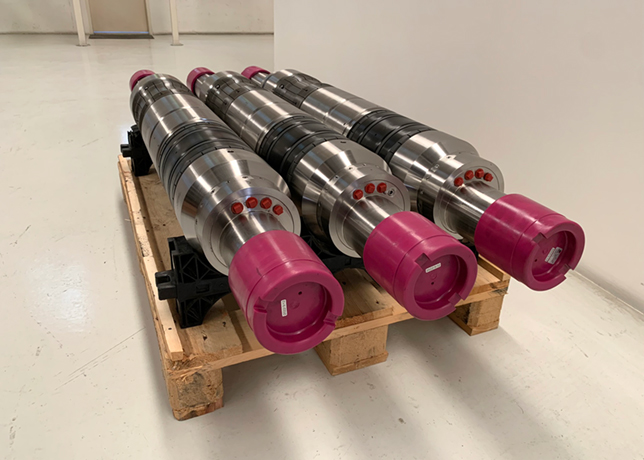
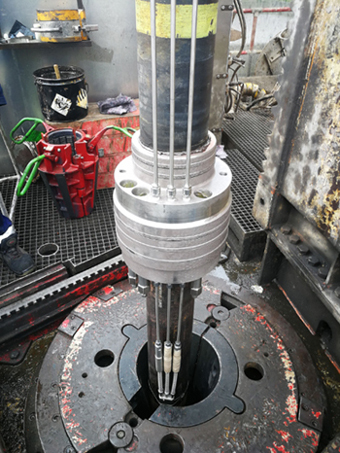
The MetalSkin system is a revolutionary metal-to-metal expandable casing system. This versatile product can be used for: increased production conduits; water shut off; corrosion retrofit; zonal isolation, and casing repair.
There are several common oilfield problems that the MetalSkin well management system is designed to tackle. These include, but are not limited to: water invasion; isolate obsolete production/injection intervals; corrosion/casing wear; isolate water/low pressure zones above production zone while maintaining ID to provide future intervention access; zonal isolation in pseudo monobore wells where certain restrictions remain in the wellbore; inter-zonal cross flow; gas migration/coning; primary and intermediate casing leaking; formation movement: casing disconnect/split; isolate leaking or damaged completion equipment
The MetalSkin system employs the compliant rotary expansion technique. In much the same way as the ELH, it delivers a metal-to-metal fit with the parent casing, maximized throughbore and increased burst and collapse of the wellbore. MetalSkin joints are comprised of an expandable threaded connection developed in conjunction with Hydril. Connections at either end allow several joints to be connected so large intervals of casing can be clad in a single deployment.
As MetalSkin systems go through future developments, opportunities will include: well geometry: enlarge production conduits to dramatically improve production in gas wells; maximum bore hanger for hanging downhole gauges, tailpipe c/w nipple etc. in monobore wells; casing repair for drill pipe key seating damage; replacement of production packer with MetalSkin to further maximize production; zonal isolation and tubing leak repairs.
In July 2002, approximately 250 ft (76.2 m) of MetalSkin was deployed across a thief zone, which included sections of ovaled casing. The application was to provide a reliable mechanical isolation of the thief zone, which was comprised of unwanted perforations and severely corroded casing in a vertical, onshore water injection well. The MetalSkin application improved the injection profile, resulting in more water to the targeted zones. Production increases were also noted in the neighboring producers.
In summary, Shell researchers estimate that eventually the Expandable tubular technology will have the potential to reduce the rig footprint by up to 75 per cent, drilling muds by 20 per cent, drill cuttings by 50 per cent and cement by 50 per cent.