


































 Japan is merging four refineries
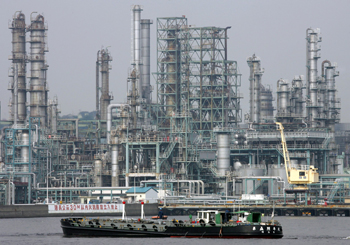
Japan, which once consumed about 10 per cent of global oil output in its refineries, is undertaking the biggest refining contraction of any country, ending a dominant era in oil markets while exposing itself to fuel imports from neighbours.
With four of its five largest refinery companies set to merge, Japan could be left with only 3.2 million barrels per day (bpd) of refining capacity by 2020 and as little as 2.3 mbpd by 2030, according to a Reuters analysis based on discussions with industry officials, analysts, government officials and suppliers. Japan may have to rely on fuel imports from China and South Korea, countries with which it shares long-standing historical disputes.
The country’s oil-refining capacity peaked at 5.6 mbpd in 1982, data from the BP Statistical Review of Energy shows, and that year global oil output was 57.3 mbpd.
Oil, and Japan’s ability to refine crude into transportation and industrial fuels such as gasoline and diesel, built the country’s modern economy. From 1965 to 1972, when Japan averaged 9.25 per cent gross domestic product growth at the height of its economic miracle, the country more than doubled its oil-refining capacity to 4.6 mbpd.
"They were the pioneers of refining in the Asia Pacific (but) that has been slowly overtaken by the giants of China and India," said Suresh Sivanandam, senior manager, refining research Asia Pacific, at Wood Mackenzie in Singapore.
"There is no single country that has cut on such a scale before," said Sivanandam.
As recently as 2008, Japanese refining capacity was 4.65 mbpd, BP data shows, making it the world’s fourth-largest processor at the time, behind the US, China and Russia. In 2014, India overtook Japan for the first time after its capacity fell to 3.7 mbpd.
Japan’s refiners are now vying for business from a shrinking, aging population that consumes less fuel because of more efficient vehicles and a turn to gasoline-electric hybrids.