
























Led by GCC solar additions, DNV projects that Mena renewable capacity will grow 10 times by 2040, while power generation will rise 14-fold as demand triples by 2060, and gas displacement will be deferred until after 2040
The Gulf Cooperation Council (GCC) states stand at the forefront of a measured but accelerating shift in Mena’s power sector.
According to DNV’s Energy Transition Outlook 2026, variable renewable generation across Mena will expand 14-fold by 2040, following a ten-fold increase in installed capacity.
Solar PV dominates, chosen for its low cost and rapid deployment; new solar projects, including those co-located with storage, grow 12-fold over the same horizon.
By 2060, non-fossil sources will supply 92 per cent of electricity, up from 14 per cent in 2024, while electricity’s share of final energy demand rises from 17 per cent to 35 per cent.
Wind capacity, currently 19 gigawatts (GW) regionally with 13 GW in Turkey and 2 GW in Egypt, is set to triple every decade to 2060, starting from a slower base due to higher development costs.
Nuclear contributes 1.6 per cent today, tripling by 2034 and again by 2060, led by UAE’s 5.3 GW operational since 2024. Hydropower holds at 5 per cent share, declining to 2 per cent by 2060 as total generation grows.
In the narrower GCC focus of the report, solar additions accelerate markedly from mid-decade onward, outpacing other Mena sub-regions.
As of June 2025, grid-connected renewable capacity across the GCC reached 16.5 GW installed with 13.5 GW under construction, up from 13.5 GW at end-2024, reported by Gulf International Forum.
This operational base remains modest relative to hydrocarbon dominance; 86 per cent of 2024 electricity was fossil-fired, primarily natural gas.
But the trajectory is clear; renewables will not displace gas-fired generation until after 2040.
Until then, rising demand from cooling, desalination, data centres, and green hydrogen will absorb nearly all new clean output.
NATIONAL TARGETS & COUNTRY PROGRESS
Policy frameworks vary in ambition and execution. Saudi Arabia targets 50 per cent renewable electricity by 2030, requiring approximately 130 GW of installed capacity.
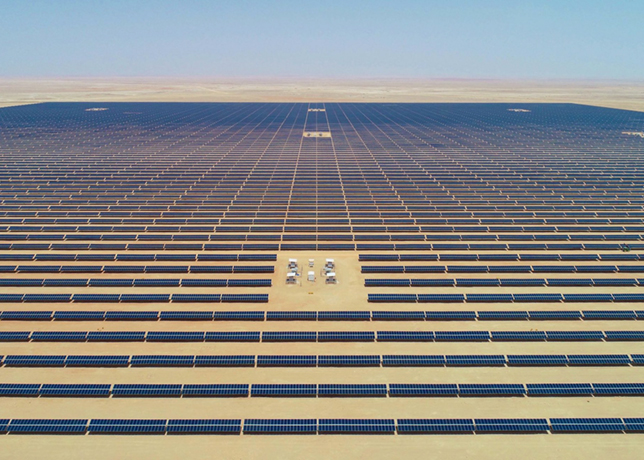 |
The 125-MWp Amin Solar PV project in Oman’s Al Wusta region |
The current progress is strong, with tenders reaching 64 GW by end-2025, including 20.6 GW awarded that year and 12.3 GW connected to the grid.
In early 2026, qualified bidders were revealed for a 3.1 GW solar tender featuring sites at Hima (1.4 GW), Bisha (600 MW), Tabarjal (500 MW), and Wadi Al Dawasir (600 MW). Plans for 14 GW awards in 2026 further underscore momentum.
The UAE aims for 30 per cent clean power by 2030 (14–20 GW) and carbon neutrality by 2050. Dubai by itself targets 75 per cent by 2050.
Recent updates affirm a push to 23 GW by 2031 and 35 per cent clean power share.
Oman seeks 30-40 per cent renewable generation by 2030 and net-zero by 2050, tendering 1.6 GW of solar and wind in early 2026, including Duqm Wind (400 MW) and Dhofar II Wind (200 MW), aiming for 6 GW solar online by 2031.
Qatar targets 4 GW solar by 2030, Kuwait 15 per cent of peak load by 2030, and Bahrain 710 MW solar and wind by 2035.
UAE and Saudi Arabia lead decisively.
Masdar’s operational portfolio includes the 2 GW Al Dhafra Solar PV (commissioned 2023) and the 400-MW Dumat al Jandal wind farm in Saudi Arabia.
ACWA Power’s 2.6-GW Al Shuaibah solar plant reached commercial operation in late 2025.
Masdar, ACWA Power, and EWEC handle generation, transmission, and offtake in vertically integrated structures.
International developers participate via FDI or consortiums, but state-owned entities retain control.
Hydrocarbons still underpin the transition, with low extraction costs and export revenues financing the build-out, while domestic subsidies (2-20 per cent of GDP) incentivise substitution to free up barrels for export.
In Oman, the Ibri III 500-MW solar-plus-storage project is due online in 2027, while the country’s first green hydrogen project, led by ACME Group, nears commissioning in Q4 2026.
Kuwait and Bahrain show slower momentum, with installed capacities at 114 MW and 69 MW respectively by 2024.
INFRASTRUCTURE REALITIES & INVESTMENT DYNAMICS
The GCC grid, modern, robust, and largely built post-2000, presents no immediate bottleneck.
Transmission and distribution lines grew 24 per cent over the past decade.
DNV expects doubling in the next 10 years and a further 52 per cent growth to 2034.
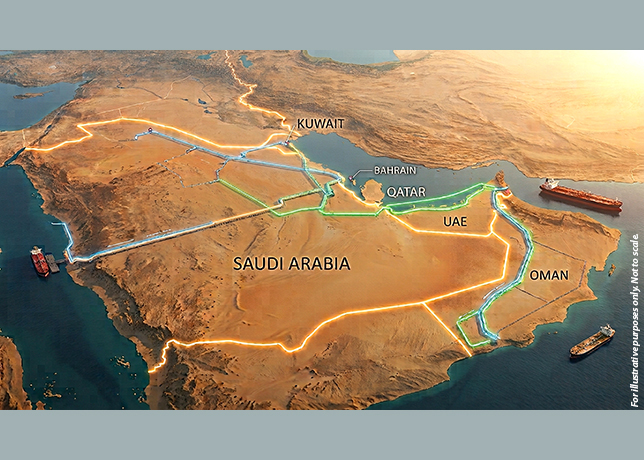
The GCC Interconnection Authority’s 900 km network, including the world’s largest back-to-back HVDC link, already enables reserve sharing and reduces required dispatchable capacity.
Extensions to Iraq (600 MW, completion Q2 2026) and a direct link to Oman (400 MW, early 2027) enhance flexibility.
From 2035, however, expansions must match renewable growth or curtailment risks emerge, with solar unaffected but wind 4 per cent lower than unconstrained potential.
This is intensifying storage requirements. While the current capacity stands at 36 GWh, DNV forecasts 9500 GWh by 2060, with batteries overtaking pumped hydro by 2026 and reaching 70 per cent of total storage.
Co-located solar-plus-storage rises from 16 per cent of solar capacity in 2024 to 50 per cent by 2044.
The Hatta pumped-storage scheme (1.5 GWh, operational 2025) and Masdar’s 1 GW round-the-clock solar-plus-19 GWh battery project (due 2027) illustrate the trend.
Short-term flexibility shifts from 94 per cent thermal today to over 50 per cent batteries by 2045.
Solar levelised cost of energy (LCOE) remains the lowest. Module prices have fallen so far that they now comprise only 14 per cent of capex in Mena.
Onshore wind LCOE sits 8 per cent above solar but will converge as expertise grows.
Green hydrogen projects, such as Neom’s 4 GW dedicated renewables for 1.2 Mt ammonia (80 per cent complete, Q4 2026 start), rely on these falling costs.
Investment flows are substantial but concentrated. Sovereign funds and utilities dominate, while international capital is entering via project finance.
DNV estimates Mena requires hundreds of billions in grid, storage, and generation assets by 2035.
The $60 billion needed across GCC for 102 GW additional renewables between 2025 and 2030, cited by Columbia Energy Policy, underscores the scale. Over $19 billion in new solar contracts were awarded in GCC in 2025 alone, per TaiyangNews.
FUTURE OUTLOOK
Over the next five to ten years, utility-scale solar will continue to dominate, with average project size exceeding 1 GW and co-located storage becoming standard.
Wind additions will remain modest until the 2030s, when offshore begins in Oman and Egypt, tripling capacity every decade.
Grid upgrades and interconnection expansion, such as GCCIA to Iraq (2026) and Oman direct link (2027), are critical.
Demand-side flexibility (desalination ramping, EV smart charging, district cooling) will be essential to manage peak-to-average ratios driven by cooling (30 per cent of demand growth to 2035).
Manufacturing demand will grow 56 per cent to 2060, with natural gas at 62 per cent direct share and electrification reaching 23 per cent.
Iron and steel production will stabilise mid-term, but then grow via scrap, with hydrogen contributing over one-third by 2050.
Desalination, consuming 6 per cent of KSA electricity today, is shifting to reverse osmosis, cutting intensity 30 per cent by 2030 but facing 45 per cent GCC water demand rise.
Buildings demand will double, cooling to 21 per cent (1,240 TWh), AI/data centres to 9 per cent (563 TWh) by 2060, concentrated in Gulf.
Growth in transport will see new electric vehicles sales at 90 per cent by 2040.
Hydrocarbons will finance the transition while anchoring baseload until 2040.
For policymakers and developers, the coming decade is about disciplined delivery: matching renewable build-out with grid reinforcement, storage deployment, and demand-response mechanisms.
Only then will the Gulf’s renewable surge translate into genuine displacement of gas and sustained decarbonisation.
By Abdulaziz Khattak