


















































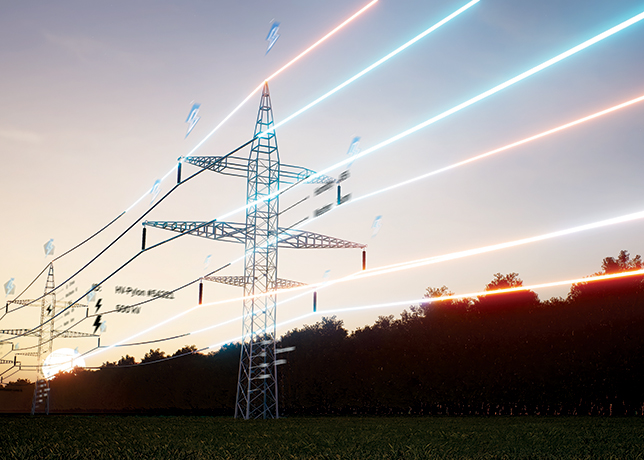
 Utilities must modernise grid management by harnessing AI
Artificial Intelligence emerges as a critical enabler for utilities facing renewable variability, aging infrastructure, and exponential demand growth across global power networks The global electrical grid stands at a pivotal juncture, confronting an unprecedented convergence of challenges that threaten its fundamental ability to deliver reliable, sustainable power.
Traditional grid management tools prove inadequate against the mounting pressures of renewable integration, extreme weather events, and surging electricity demand driven by transport electrification, manufacturing reshoring, data centre expansion, and cryptocurrency mining.
Utilities must modernise grid management by harnessing artificial intelligence (AI) to achieve greater grid stability, resilience, and efficiency, with these technologies enabling near real-time data processing, seamless integration of renewable energy sources, reduced outages, and robust cybersecurity frameworks.
The scale of operational complexity facing grid operators has reached critical levels, with over 40,000 new cybersecurity vulnerabilities identified in 2024 alone.
Human errors contributed to 40 per cent of maloperations in the US during 2022, whilst in-person management activities cost up to $1,000 per truck roll.
These figures underscore the urgent need for software-driven automation that can process vast datasets and execute decisions with precision impossible for manual operations.
FIVE PILLARS OF AI-ENABLED GRID OPERATIONS
AI system requirements form the foundation of modernised grid management through five core capabilities that address renewable variability and infrastructure stress:
• Distilling raw data automatically extracts insights from high-volume sources including smart metres and IoT devices, filtering noise to identify critical patterns such as voltage anomalies for precise monitoring.
• Nowcasting generates short-term forecasts spanning minutes to hours for renewable energy output and load fluctuations, utilising near real-time weather and demand data to enable rapid adjustments maintaining grid stability.
• Predicting capabilities forecast long-term grid trends including seasonal demand and equipment wear, supporting strategic maintenance planning and renewable energy integration across extended time horizons.
• Optimising functions dynamically adjust grid parameters like storage dispatch to balance supply and demand efficiency across distributed resources, including microgrids operating under varying constraints.
• Autonomous control enables network division into zones responding instantly to disruptions, improving reliability in distributed environments without human intervention.
QUANTIFIABLE PERFORMANCE GAINS
Current market data demonstrates that automating near real-time load balancing and fault detection cuts response times by as much as 30 per cent, significantly improving operational agility.
AI-driven analytics process 250 terabytes of data from the US grid, whilst synchrophasor-based analysis achieves 33 per cent fault prediction accuracy.
Asset management systems continuously monitor equipment for anomalies, delivering 80 per cent failure prediction accuracy that transforms maintenance from scheduled to condition-based approaches.
These capabilities translate traditional reactive maintenance into proactive resource allocation, reducing capital and operational costs whilst extending asset lifespans.
Network modelling leverages AI to create digital representations of grid infrastructure, enabling utilities to simulate performance and test scenarios virtually before physical implementation.
This application proves crucial for addressing aging infrastructure challenges, as utilities test solutions without risking operational disruptions or committing extensive capital to unproven approaches.
DEPLOYMENT ARCHITECTURE & INTEGRATION
Successful implementation requires hybrid cloud-edge architectures balancing centralised data processing with near real-time decision-making at grid assets.
Cloud platforms enable advanced analytics forecasting renewable energy variability across large regions, whilst edge computing processes data closer to substations, reducing transmission requirements and latency.
Integration with existing supervisory control and data acquisition systems, energy management systems, and distributed energy resource management systems allows utilities to upgrade incrementally without disrupting operations.
Digital-first, software-driven approaches enable zonal autonomous control capabilities, allowing utilities to manage specific grid segments independently and improve response times to localised issues.
These solutions scale from small municipal systems to large regional networks, ensuring adaptability across diverse utility contexts and grid configurations.
IMPLEMENTATION CHALLENGES & RESPONSES
Data quality and standardisation present fundamental obstacles, as legacy systems produce fragmented information with varying formats, quality levels, and temporal resolutions.
Utilities must implement governance frameworks with cleansing and standardisation tools, adopting global interoperability standards such as IEEE P2030 to ensure seamless integration across different grid systems.
Cybersecurity demands escalate with distributed, virtualised architectures, requiring active defences through AI-driven anomaly detection identifying threats instantly.
Assets, sensors, data, and AI models deployed at the edge expand attack surfaces requiring protection, with encrypted protocols securing data exchanges consistent with NERC and global standards.
Future-proofing systems without creating complexity requires architectures capable of simultaneous adaptation to latest data, algorithms, and technologies, preventing utilities from falling behind as innovation accelerates beyond traditional deployment cycles.
Workforce development emerges as critical, with AI-driven grids requiring personnel proficient in interpreting predictive alerts, managing autonomous systems, and utilising advanced analytics tools.
Phased rollout strategies prove essential, with pilot projects in targeted segments validating performance and assessing scalability before full-scale implementation across larger grid networks.