































































Berkeley Earth, an independent California-based climate monitoring organisation, in its 2025 Annual Temperature Report, confirmed that 2025 was the third warmest year on Earth since 1850, following 2024 and 2023.
The global average temperature in 2025 was estimated at 1.44 ± 0.09 deg C above the 1850–1900 pre-industrial baseline.
The last 11 years (2015–2025) constitute the warmest decade on record, with 2023–2025 showing a sharp warming spike, indicating an acceleration in the Earth’s warming rate.
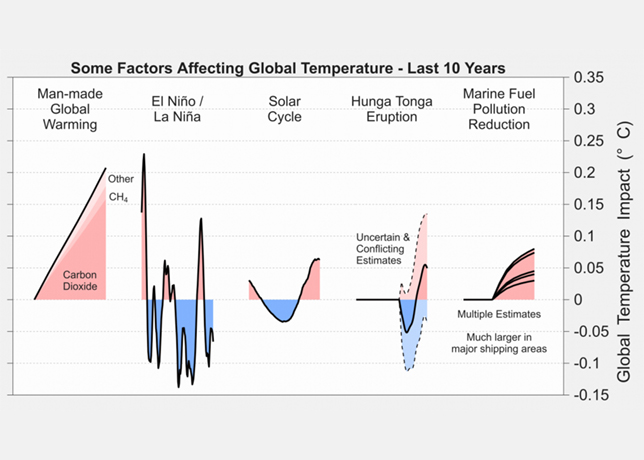
Robert Rohde, Berkeley Earth Chief Scientist, noted that while greenhouse gas emissions remain the main driver, additional factors, such as reductions in low cloud cover and atmospheric aerosols, have likely amplified recent warming.
Data were derived from the High-Resolution Surface Temperature dataset (BEST-HR), integrating 23 million monthly-average readings from 57,685 weather stations and ~500 million ocean temperature measurements.
Key findings include: 9.1 per cent of Earth’s surface experienced record-warm annual averages in 2025, affecting 770 million people, primarily in Asia, with 450 million in China.
No region recorded record cold conditions.
Despite 2025 being a modest La Niña year—which usually cools global temperatures—the cooling effect was minimal, reflecting underlying warming trends.
Berkeley Earth emphasises that the 2023-2025 spike demonstrates how quickly the climate system can shift and the need for sustained, high-quality climate monitoring to guide governments, industries, and communities with real-time evidence.
Looking ahead, 2026 is expected to be similarly warm, potentially the fourth warmest year since 1850, though variability remains possible.
The report highlights that past warming rates may no longer reliably predict short-term future trends, underscoring the urgency of continued observation and mitigation efforts.