















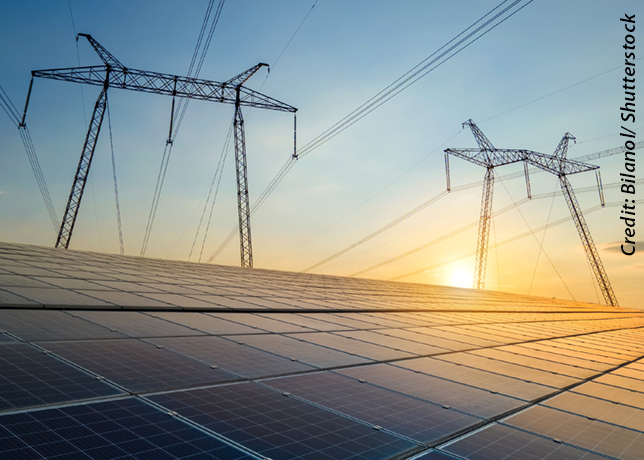

















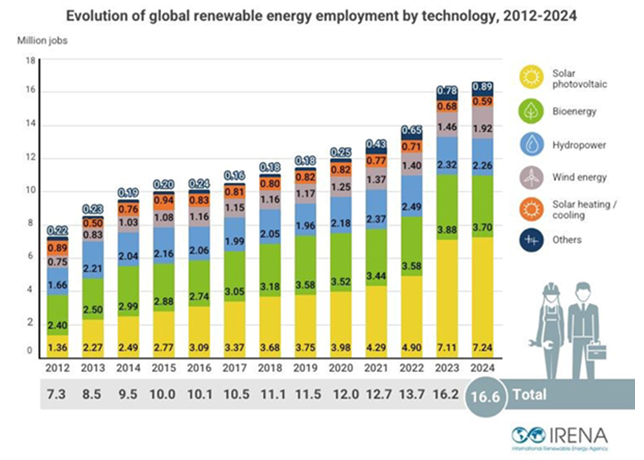
Despite record renewable energy installations, global employment in the sector grew just 2.3 per cent from 2023, reaching 16.6 million jobs in 2024, according to the Renewable Energy and Jobs Annual Review 2025 by IRENA and the ILO.
Geopolitical tensions, geoeconomic frictions, and rising automation are affecting workforce growth. Uneven regional development persists, with China leading by a wide margin, creating 7.3 million jobs (44 per cent of the global total).
The EU remained steady at 1.8 million jobs, while Brazil reached 1.4 million, and India and the US saw minimal growth to 1.3 million and 1.1 million, respectively.
By technology, solar photovoltaics (PV) dominates, employing 7.3 million people globally, 75 per cent of them in Asia, with China accounting for 4.2 million.
Liquid biofuels created 2.6 million jobs, hydropower 2.3 million, and wind 1.9 million.
The report emphasises the need for a just and inclusive energy transition. Women, people with disabilities, and other marginalised groups remain underrepresented.
Ensuring diversity, equity, and inclusion requires systemic policy frameworks, including accessible education, training, and labour market services.
Stakeholders must have a seat at the table, and discriminatory practices and outdated norms must be eliminated.
A truly inclusive renewable energy workforce will better support sustainable growth and deliver broader economic benefits for communities worldwide.
Francesco La Camera, IRENA Director-General, said: "Renewable energy deployment is booming, but the human side of the story is as important as the technological side. Governments must put people at the centre of their energy and climate objectives through trade and industrial policies that drive investments, build domestic capacity, and develop a skilled workforce along the supply chain. The geographical imbalance of the job growth reminds us to get international collaboration back on track. Countries that are lagging behind in the energy transition must be supported by the international community. This is essential not only to meet the goal of tripling renewable power capacity by 2030, but also to ensure that socio-economic benefits become lived realities for all, helping to shore up popular support for the transition."